"Gold is immortal, because it simply can't be bothered to decay." — A joke a chemistry teacher might make, yet it captures an entire history of civilization.
The Legacy of Stars
13.8 Billion → 4.5 Billion Years AgoTo tell the story of gold, we need to zoom out a hundred million times farther than human civilization. Gold atoms weren't on the universe's original shopping list — in the first three minutes after the Big Bang, only light elements like hydrogen and helium could form. Even "ordinary" elements like gold, silver, and iron had to wait for stars to ignite before they could be forged. But even ordinary stars can't produce gold when they die: a star like our Sun can only produce elements like carbon, oxygen, and iron over its lifetime. The birth of gold requires one of the most violent events in the universe — the collision and merger of neutron stars. Two city-sized objects, each weighing a billion tons per teaspoon, collide in the final thousandth of a second, releasing a flood of free neutrons that slam into atomic nuclei and forge heavy elements like gold. In August 2017, humanity both "heard" the gravitational waves of two merging neutron stars (GW170817) and "saw" the light of their explosion, confirming this cosmic alchemy pathway. As for the gold you can find in Earth's crust today — when Earth first formed, heavy elements sank into the core along with iron. Most of the gold on the surface now was likely delivered by countless meteorites and small celestial bodies "bombarding" Earth over more than four billion years. In other words, every gold ring is an insurance claim from a cosmic car crash.
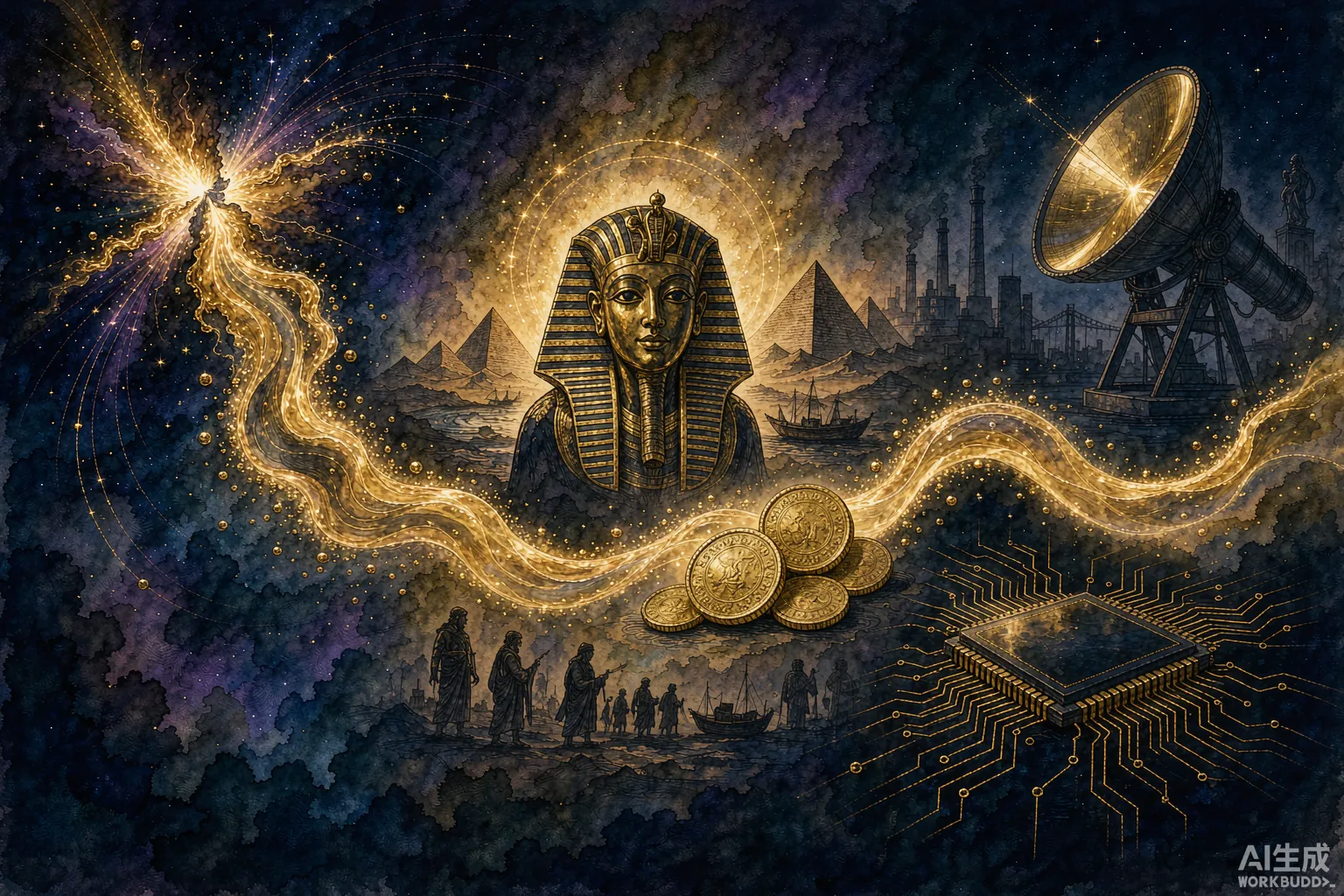
◆ Science Insight: Why Is Gold "Immortal"?
Gold's chemical properties are extraordinarily stable: it barely reacts with oxygen, water, or common acids and bases (only aqua regia and a few other heavy hitters can touch it). Iron rusts to dust, copper develops green patina, paper decays — yet gold after five thousand years looks exactly as it did the day it was made. Gold's "noble" social status rests on a pure chemical fact: it simply can't be bothered to participate in most chemical reactions. Even better, gold's stability and its "preciousness" share the same origin: what chemists call "relativistic effects" cause gold's outer electrons to cling extra tightly, which both makes it absorb blue light (giving it that golden hue) and makes it refuse to bond with other elements. Gold's color, its immortality, and its rarity are all three lines written by the same law of physics. Civilization merely translated that chemical property into theology, royal power, and currency.
◆ Science Insight: Why Is There So Little Gold on Earth?
Gold makes up only about four parts per billion of Earth's crust — and that's before counting the vast majority that sank into the core. To concentrate enough gold into a mineable deposit, underground hydrothermal fluids need to shuttle extremely sparse gold atoms, enriching them over millions of years. To put it another way: all the gold ever mined by humanity — roughly 200,000+ tons — melted together would form a cube only about 22 meters on each side, not enough to fill a small swimming pool. Scarcity isn't gold's weakness; it's half its calling card. The other half — "immortality" — ensures that nearly every ounce of gold ever mined never disappears from the books. Every gram mined over five thousand years is still in circulation today.
The First "Golden Age"
c. 4600–1300 BCEThe earliest known large-scale use of gold comes from the Varna culture on the Black Sea coast of Bulgaria: graves dating back roughly 6,600 years contain thousands of gold artifacts — and writing hadn't even been invented yet. Humanity already knew to bury "things that never break" with "people who would never return." Archaeologists read another layer of meaning in these graves: the gold was distributed extremely unevenly. The richest grave held most of it, while the rest were nearly empty — from the very moment it appeared, gold played the role of "distinguishing people." In ancient Egypt, the pharaoh was called the "living Horus," and gold was considered the flesh of the gods: because it shone like the sun forever and never faded. Tutankhamun's golden mask, weighing over ten kilograms, wasn't a luxury item — it was a theological statement written in metal: may the pharaoh's face endure as long as the sun. Meanwhile in the East, bronze figures at Sanxingdui were covered with golden masks, and the Jinsha site yielded paper-thin gold foil of the Sun Bird — ancient civilizations across the world independently arrived at the same choice: to place the most imperishable metal on the most important faces.
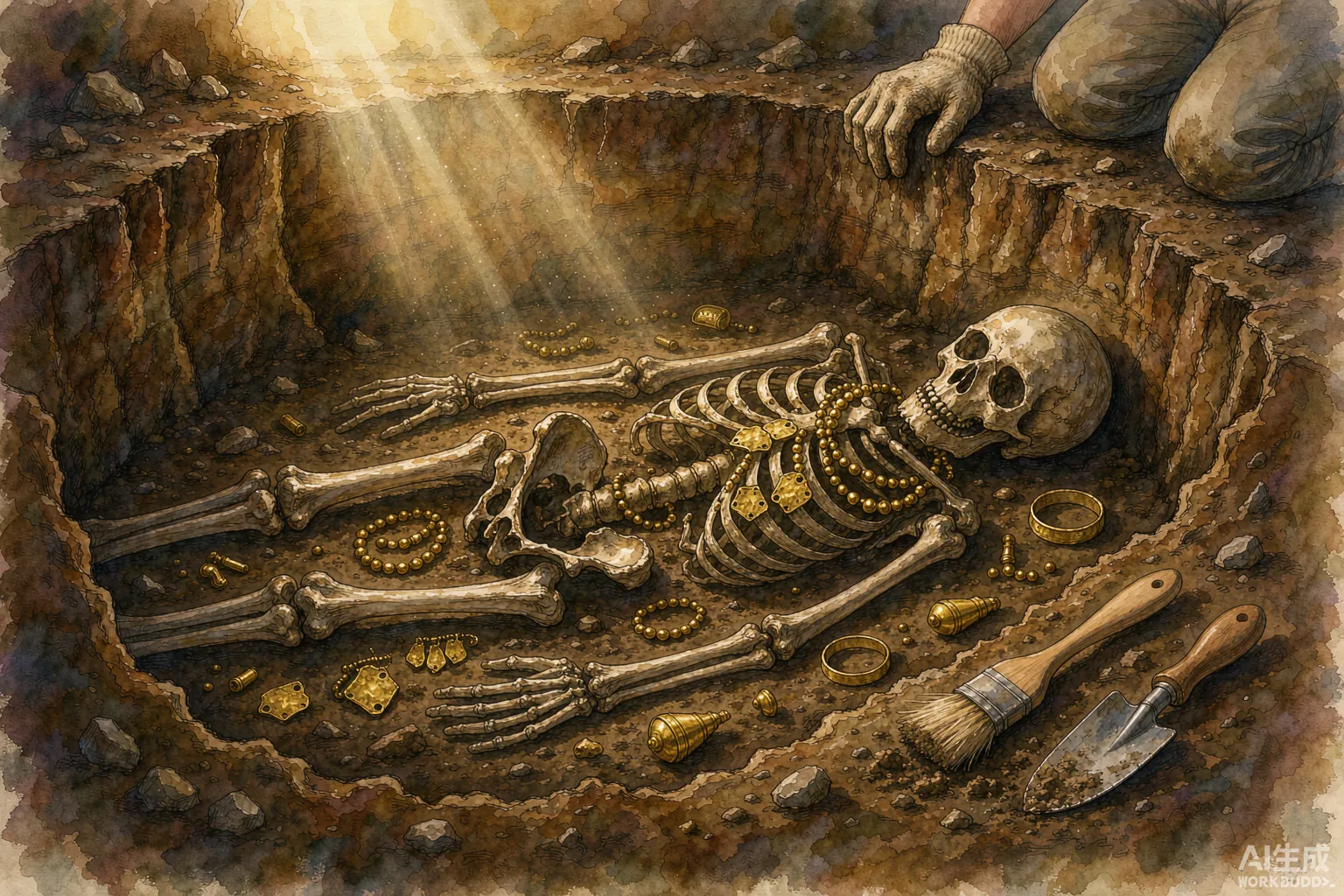
◆ Historian's Note: Gold's "Social Invention"
Note a crucial point: for thousands of years before gold became money, it was first the language of religion and power. Offering the most imperishable material to the most important beings — gods, kings, the dead — that ranking itself is a snapshot of ancient values. The wealth inequality at Varna, Egypt's "flesh of the gods," Sanxingdui's golden masks — they all say the same thing: understand who gets to wear gold, and you understand who holds power.
Minted into Coins: Gold Enters the "Ledger Age"
c. 7th Century BCE – 2nd Century CETurning gold into money was a decisive step in the history of human commerce. In the late 7th century BCE, the Kingdom of Lydia in Asia Minor minted the earliest known state-issued coins — electrum (a natural gold-silver alloy). Soon after, King Croesus issued pure gold coins. The great innovation of coinage was outsourcing trust: you no longer had to weigh and assay every piece; you only needed to trust the king's stamp. Persian darics traveled with armies across continents, and Roman aureus coins once circulated throughout the Mediterranean world. From then on, gold completed its triple leap: ornament → sacred object → currency — its "immortality" could now fit in a pocket, make change, and be deposited in a bank.
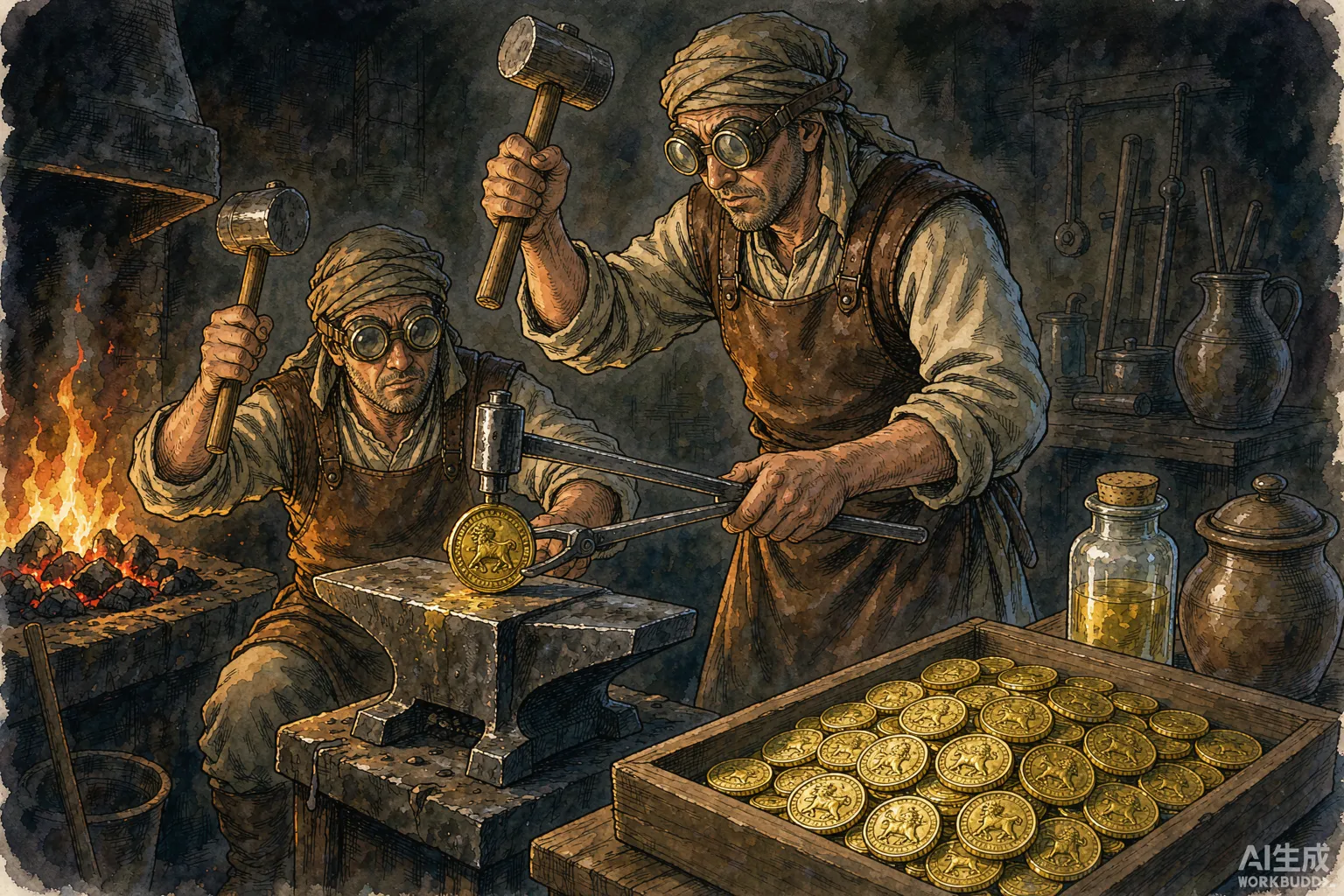
◆ Historian's Note: The Stamp Is a Promise
The deepest invention in coinage wasn't the metal — it was the stamp. It was the first time a state "backed" abstract value. Everything on modern banknotes — anti-counterfeiting features, signatures — logically begins with that tiny gold coin stamp. Only when trust could be "minted" into metal did commerce dare to step beyond the circle of familiar faces.
◆ Science Insight: Bad Money Drives Out Good — The Side Effect of Coinage
Coinage had another unexpected consequence. Lydia's electrum was a natural mix of gold and silver, with inconsistent purity. Once the state had the power to decide the "gold content" of coins, it also held the handle for cutting corners. In the later Roman Empire, as military expenses soared, the silver content of coins was debased from 90% down to less than 5%, and prices skyrocketed. People melted down and hoarded the older, purer coins, spending only the debased ones — this is "Gresham's Law": bad money drives out good. It reveals a principle still valid today: whenever value is determined by someone else's say-so, even the most honest metal can't guarantee honest circulation. Every inflation in the age of paper money is a variation on this theme.
Gold in the East: A Different Path
221 BCE – 1911 CEAn interesting question: why didn't ancient China follow the Mediterranean world down the gold-coin road? The answer lies in social structure. After unification, the Qin dynasty established a copper coin + state credit system: coin face values were set by the state, and transactions were counted by number rather than weighed — this was the world's earliest large-scale "counting currency." Gold wasn't absent in China: the state of Chu used gold plates, the Han dynasty had gold discs and horse-hoof-shaped gold ingots, and emperors awarded gold by the "jin" (a unit of weight). But gold mainly served as store of value and large-scale payment — it never descended to the level of everyday small change. By the Song and Yuan dynasties, China had gone even further, inventing paper money (jiaozi, huizi, baochao) — using paper to represent value, relying entirely on state credit. Gold thus retreated behind the scenes: gold ingots stored in vaults, gold objects buried with the dead, gold jewelry given as dowry. The same metal was assigned completely different roles in East and West — the form of money is, in fact, a medical report on how a society organizes trust. The Mediterranean world built trust between strangers on "the weight of metal"; China tried earlier to build trust on "the promise of the state." Both paths had their victories and their stumbles.
◆ Historian's Note: The Form of Money Is a Mirror of Society
Compare the choices of East and West, and you'll discover a historian's "detective rule": look at what a society uses as money, and you'll know what it trusts most. Trust in physical goods leads to weighed metal; trust in the state leads to copper coins and paper notes with government-set face values. Interestingly, when China's paper money collapsed during the Ming dynasty, the country regressed to "trusting the physical substance of silver" — this detour is precisely the starting point of the next installment, "The History of Silver."
The Golden Rush: Gold Reshapes the World
1848–1914In the nineteenth century, gold remade the world in a new way: three great gold rushes. In 1848, gold was discovered in California; the following year, hundreds of thousands of people from around the globe flocked there, giving San Francisco its name. Impoverished farmers from southern China also crossed the ocean, turning "Gold Mountain" into a frequent phrase in letters home to their diaspora communities. In 1851, Australian goldfields sparked the second wave, and Melbourne earned the nickname "New Gold Mountain." In 1886, the Witwatersrand goldfields in South Africa burst onto the scene, transforming Johannesburg from wilderness into a mining metropolis — also planting the seeds for the Anglo-Boer War and a century of South African history. The gold rushes weren't just get-rich stories: they redrew population maps, railway maps, and power maps. Riverbeds in mining regions were blasted apart by hydraulic cannons, and indigenous lands — along with an era's ecological bill — were charged to the world's gold price. Meanwhile, major nations adopted the gold standard: currency values were anchored to gold, exchange rates were fixed, and international trade entered an era of interlocking "metal gears" — globalization unfolded for the first time under a unified metallic coordinate system.
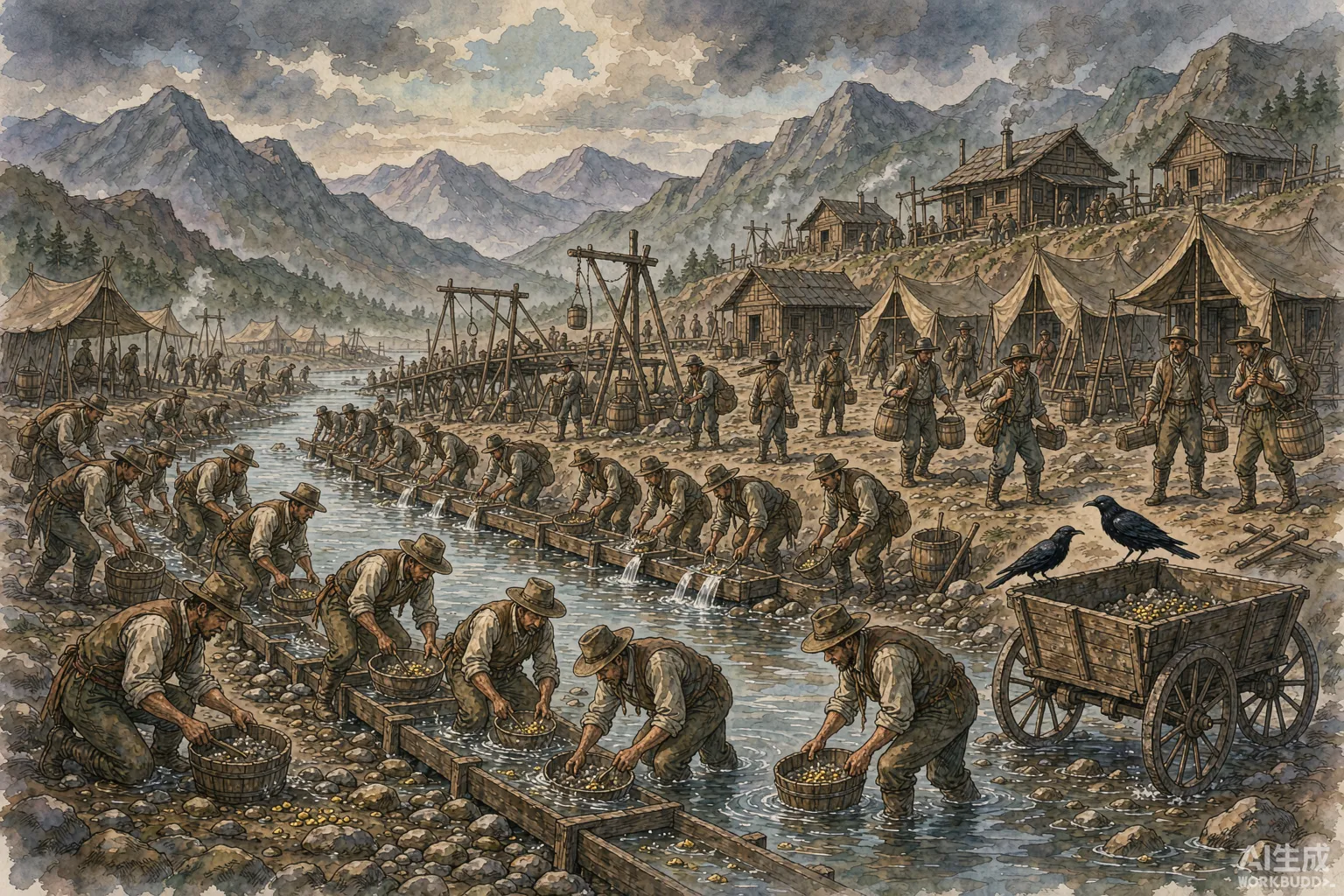
◆ Historian's Note: The Two Faces of the Gold Standard
The gold standard's advantage was its "hardness": governments found it difficult to print money recklessly, and currency values were stable and predictable. But the cost was also its "hardness": during economic crises, all of society was locked into gold's supply — central banks couldn't increase the money supply to mount a rescue. During the Great Depression, countries hesitated to leave the gold standard for too long; it was dubbed "the golden straitjacket." Economic historians later reached a consensus: the sooner a country broke free, the faster it recovered. Even a good thing's "goodness" has limits.
Gold's Dark Side: The Empire's Ledger
16th–19th CenturiesWhen historians talk about gold, they must open two ledgers at once. The first is the empire's ledger of plunder: in 1521, Cortés conquered the Aztec capital and melted tons of golden objects from palaces and temples into ingots for shipping home — to the conquerors, millennia of sun worship were merely "raw material priced by weight." The sun temples of the Andes, the trading posts of West Africa's "Gold Coast," the triangular trade routes that interlocked with the slave trade — all followed the same logic: wherever gold was most concentrated, that's where violence went. The second ledger is the list of the dead: laborers in colonial mines and along trade routes, temples stripped of their golden crowns, indigenous peoples stripped of their land. Many of the heavy reserves sitting in central bank vaults today were, centuries ago, someone else's sacred statues and ancestral burials. In recent years, museums across Europe have begun discussing the return of gold artifacts looted during the colonial era. This "repatriation debate" is itself a homework assignment for history: reckoning with the past isn't about stoking hatred — it's about making sure that next to "what's valuable," there always stands "a valuable lesson."
◆ Historian's Note: Both Ledgers Must Be Read
A history of gold that only reads "civilizational achievement" becomes an advertisement; a history that only reads "accusations of blood and tears" loses its bearings. Historical honesty means holding both ledgers at once and asking about their relationship: the glory of empire and the darkness of the mine shaft aren't two stories — they are two sides of one story. This is the consistent method of this series — beneath the horse's relay station are the relay runners, beneath the woolen cloth are the dispossessed victims of enclosure, beneath gold's crown are the miners.
Leaving the Gold Anchor: The 1971 Watershed
1931–1971Two world wars tore the gold standard apart: countries printed money for war, and the gold anchor kept slipping its chain. In 1944, the Bretton Woods system struck a compromise — the US dollar was pegged to gold (35 dollars per ounce), and other currencies were pegged to the dollar. But this system contained a self-undermining mechanism, which economist Triffin identified: for the world to use dollars in trade, the US had to keep sending dollars overseas; the more dollars sent abroad, the less likely there would be enough gold to back them — either the world runs short of money, or the US breaks its promise. One or the other was inevitable. By 1971, American gold reserves could no longer meet the world's redemption demands, and Nixon announced the closure of the "gold window." From then on, humanity as a whole entered the age of fiat currency: money's value was no longer backed by metal, but by state credit and economic output. Gold stepped into a secondary role, becoming the "ultimate collateral" in central bank vaults and a "safe-haven symbol" in the public mind — interestingly, during the 2008 financial crisis and the 2020 pandemic, central banks actually increased their gold holdings: humanity says it trusts credit, but its actions honestly kept an "old anchor" close at hand.
◆ Science Insight: Where Alchemy Went Wrong — and Where It Was Right
Ancient alchemists wanted to turn base metals into gold, but their approach was entirely wrong at the chemical level — gold is an element, and chemical reactions can't change atomic nuclei. But their furnaces, distillations, and record-keeping habits inadvertently gave birth to modern chemistry. To actually turn one element into gold, you have to change the atomic nucleus: particle accelerators have indeed created gold atoms (using mercury or bismuth as raw materials), but at a cost billions of times the price of gold — the universe "makes gold" inside neutron stars; humans in a laboratory "make" a few atoms at enormous expense, purely as an expensive scientific tribute. This also explains gold's ultimate scarcity: the entire solar system cannot naturally produce gold. Every gram on Earth is the legacy of an ancient neutron star catastrophe.
The Industrial Age: Gold's Second Life
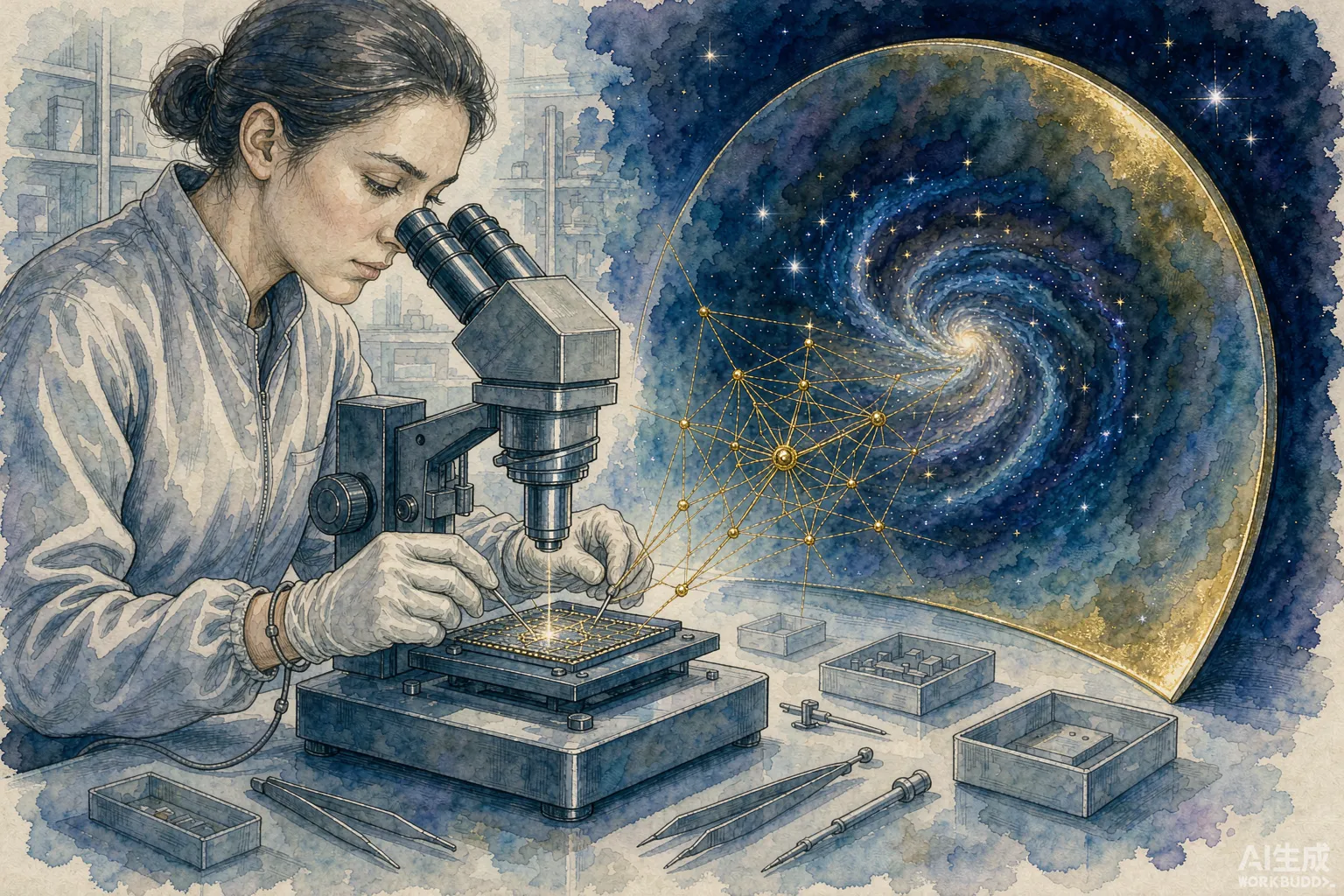
20th Century to PresentEntering the twentieth century, gold quietly changed jobs. It still lies in central bank vaults and wedding jewelry — the vast majority of all gold ever mined still "lives on" in the form of bars and ornaments, confirming its original identity: the most successful savings instrument in human history. But in places you can't see, it has gone to work: every phone, every computer contains a thumbnail-sized golden contact and hair-thin bonding wires — circuits need a metal that will never oxidize, conducts reliably, and stands up to demanding conditions. Only gold perfectly fits the bill. Look higher: the James Webb Space Telescope's eighteen mirror segments are all coated in gold — that layer, thinner than a bubble wrap film, gently reflects the faintest infrared light from the cosmos into humanity's gaze. And in medical laboratories, gold nanoparticles just a few nanometers across are learning new jobs: precisely delivering anti-cancer drugs to the doors of tumor cells, or displaying that red line on a pregnancy test — from pharaoh's mask to telescope mirror, gold has always been doing the same thing: helping humanity gaze at "eternity."
◆ Science Insight: Why Gold, Not Cheaper Silver or Copper?
For conductivity, silver ranks first, copper second, gold only third. But silver tarnishes black from sulfur, copper oxidizes into green patina — in harsh environments of moisture, high heat, and millions of connection cycles, the moment a contact surface oxidizes, the signal breaks. Engineering choices are never about "who's strongest" but "who's most stable": gold's chemical inertness means it doesn't need replacing for decades. This is the same chemical principle behind its five-thousand-year history of incorruptibility. As a side note, recovering gold from a ton of old phones yields far higher grades than a ton of gold ore — your desk drawer might contain a miniature "gold mine." This is the starting point of today's urban mining science.
The Unchanging Thing, Reflecting an Ever-Changing Humanity
Written for Future ReadersLooking back over these six thousand years, you'll discover a moving irony: gold did nothing at all — it doesn't decay, doesn't depreciate, doesn't rust, sitting quietly like a fossil. Yet around it, humans built temples, minted coins, launched expeditions, established and then toppled monetary systems. What gold truly records has never been itself — it's each generation's answer to "what is worth entrusting." The ancient Egyptians entrusted it with eternal life, the Lydians with credit, the Victorians with order, and modern people with a sense of security. The metal doesn't change; human hearts do — and that is precisely where the light in a historian's eyes comes from when looking at gold.
Also remember its other side: the history written for it is soaked in the blood of miners in the Americas and Africa, soaked in the accounts of war and colonization. When you stand before a glass case in a museum looking at a golden crown, may you see both the embers of a neutron star merger and the names of those who never made it out of the mine. The meaning of reading history is to ensure that next to "what's valuable," there always stands "a valuable lesson."
◆ Three Questions for the Whole Essay
1. Gold's chemical inertness, scarcity, and divisibility — which need of currency does each correspond to?
2. When humanity left the gold anchor in 1971, was it liberation or risk? Give one reason for each.
3. "Unchanging" gold and "ever-changing" humanity have shaped each other — if you had to choose a new "thing to entrust" for the future, what would it be?
Gold: A Timeline of Key Events
c. 4600 years ago Varna gold burials · 14th century BCE Tutankhamun's golden mask · Late 7th century BCE Lydia's first coins · 221 BCE Qin unifies copper coinage · 1848 California Gold Rush · 1886 South Africa's Witwatersrand goldfields · 1944 Bretton Woods system · 1971 US dollar decoupled from gold · Today Central bank reserves, electronics industry, and nanomedicine in parallel