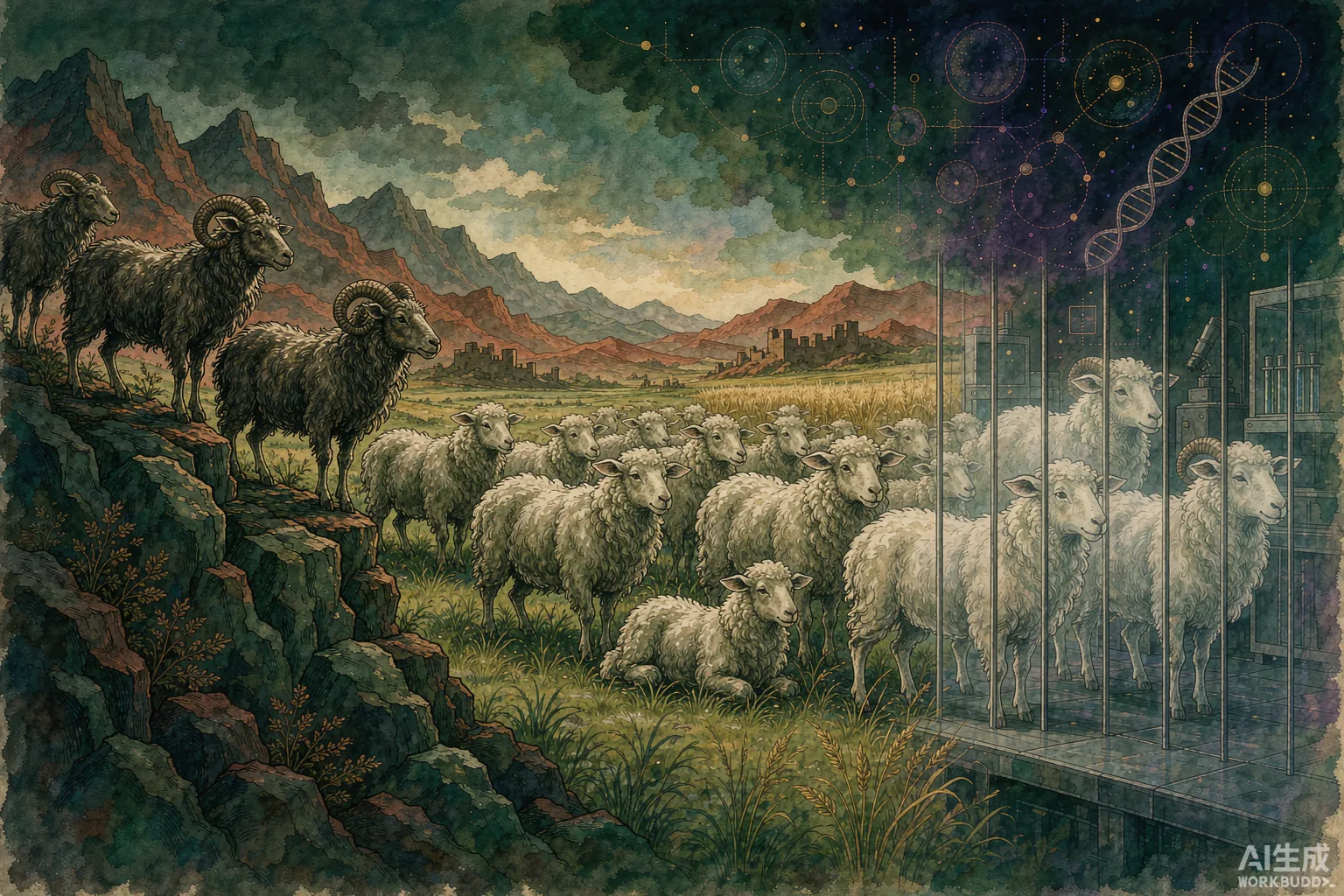
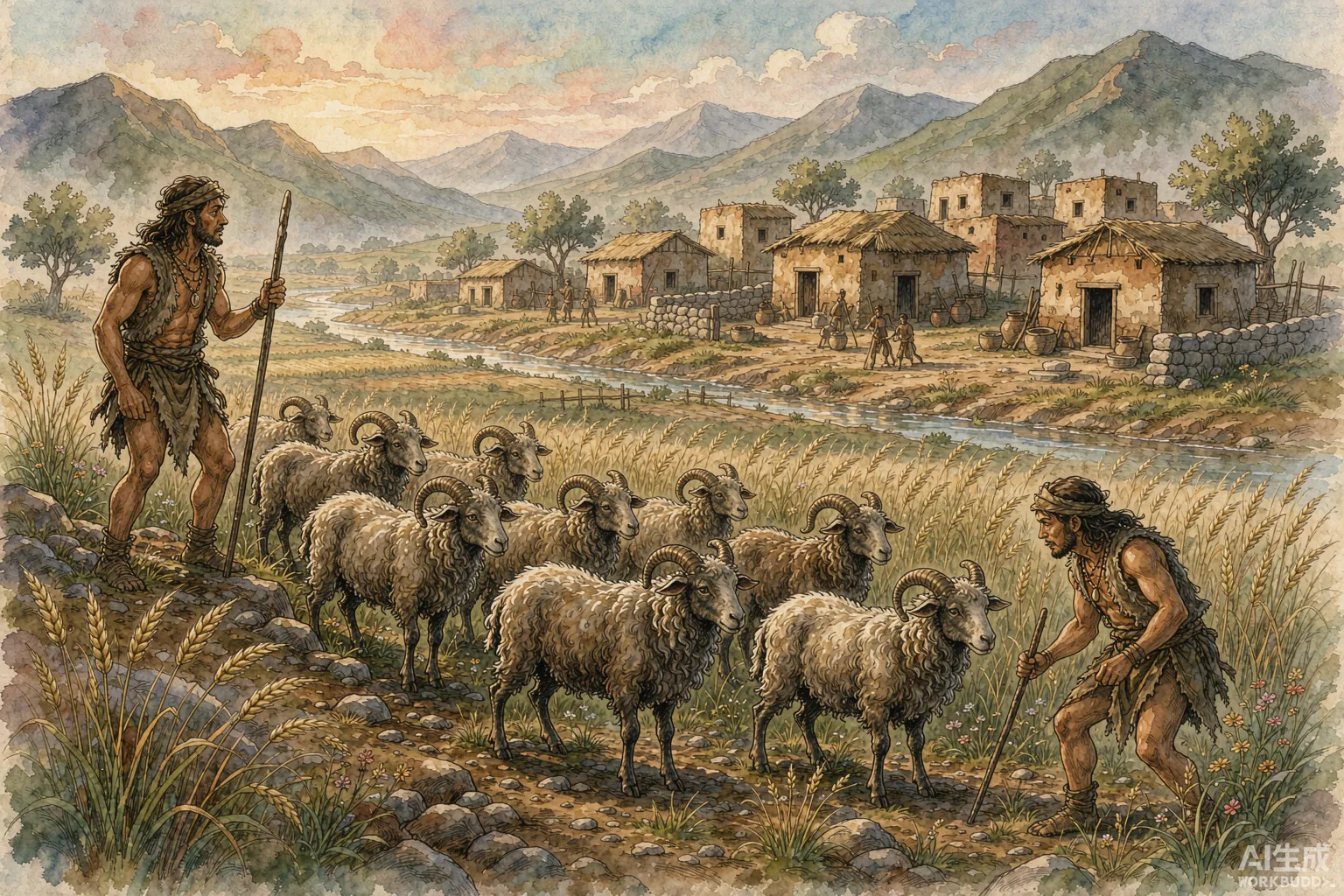
Historian's NarrationThe story of animal domestication usually begins in the arc-shaped highlands of the Fertile Crescent, and sheep are right there on the very first page. Around 11,000 years ago, hunter-gatherers in Western Asia began systematically managing wild sheep populations. Archaeologists can see the changes clearly in excavation sites: the average age of the flock dropped (people began slaughtering young sheep), and the male-to-female ratio shifted (more ewes were kept for breeding). These were not changes in genes, but changes in management — the first step of domestication was not about changing the animal, but about changing the relationship between humans and animals.
◆ Science Insight: Sheep and Goats — Two Separate Domestications
Many people assume sheep and goats are one family, but their wild ancestors were different: sheep descended from the mouflon of the Western Asian highlands, while goats descended from the wild goat (a close relative of the ibex). Genomic evidence shows that the two were independent domestication events, though they happened around the same time. Also, the bones and teeth of early domesticated animals gradually changed in form — becoming smaller and shorter — a phenomenon called the "domestication syndrome": ears drooping, snouts shortening, brain capacity slightly reduced. This is exactly the same pattern we saw with pigs in Book Two. It's the same developmental rules playing out across different species.
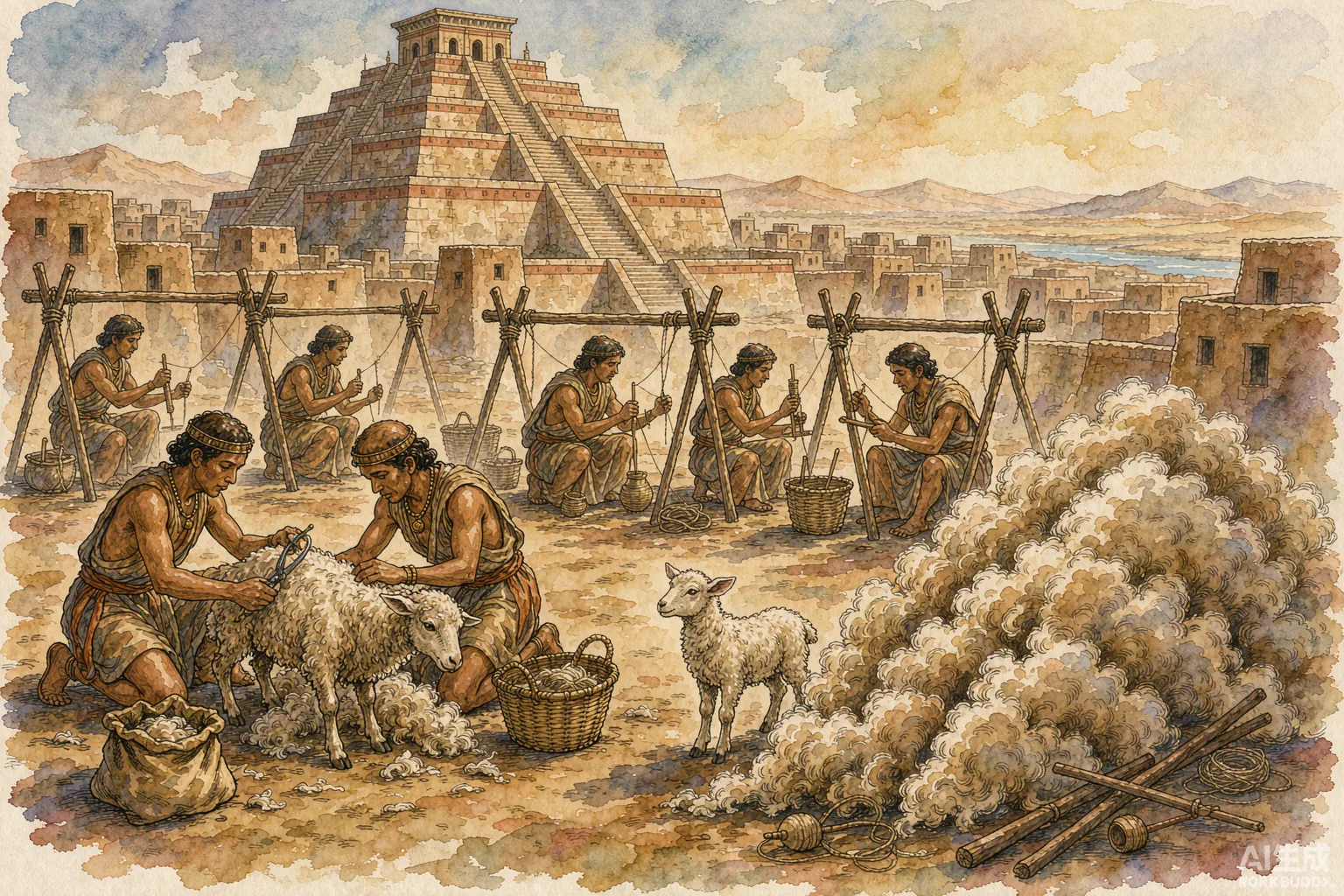
Historian's NarrationHere's a fact many students may not know: the earliest sheep had no real "wool." Mouflon and early domesticated sheep had coarse, short hair, like goats, and shed it all at once each spring. That fluffy, cloud-like fleece you can shear and spin into cloth was something shepherds "selected for" over thousands of years. By the Bronze Age in Mesopotamia, wool had become a major commodity on par with grain in clay tablet records: temples distributed wool rations to weavers, and palaces used wool to pay soldiers. Humanity's first "industrial raw material" was very likely wool.
◆ Science Insight: A Sweater Is a Triumph of Gene Expression
Sheep skin has two types of hair follicles: primary follicles produce coarse, straight "hair," while secondary follicles produce fine, soft, curly "fleece." Wild sheep are dominated by primary follicles; but thousands of years of artificial selection favored individuals with increased secondary follicle proliferation and enhanced keratin gene expression — today's fine-wool sheep can have several times more secondary follicles than primary ones. Note: no "foreign genes" were introduced here. Instead, the entire regulatory network controlling fleece development was rewritten — the same principle as the VRTN story with pigs in Book Two. What artificial selection is best at turning is precisely the "knobs" of gene expression.
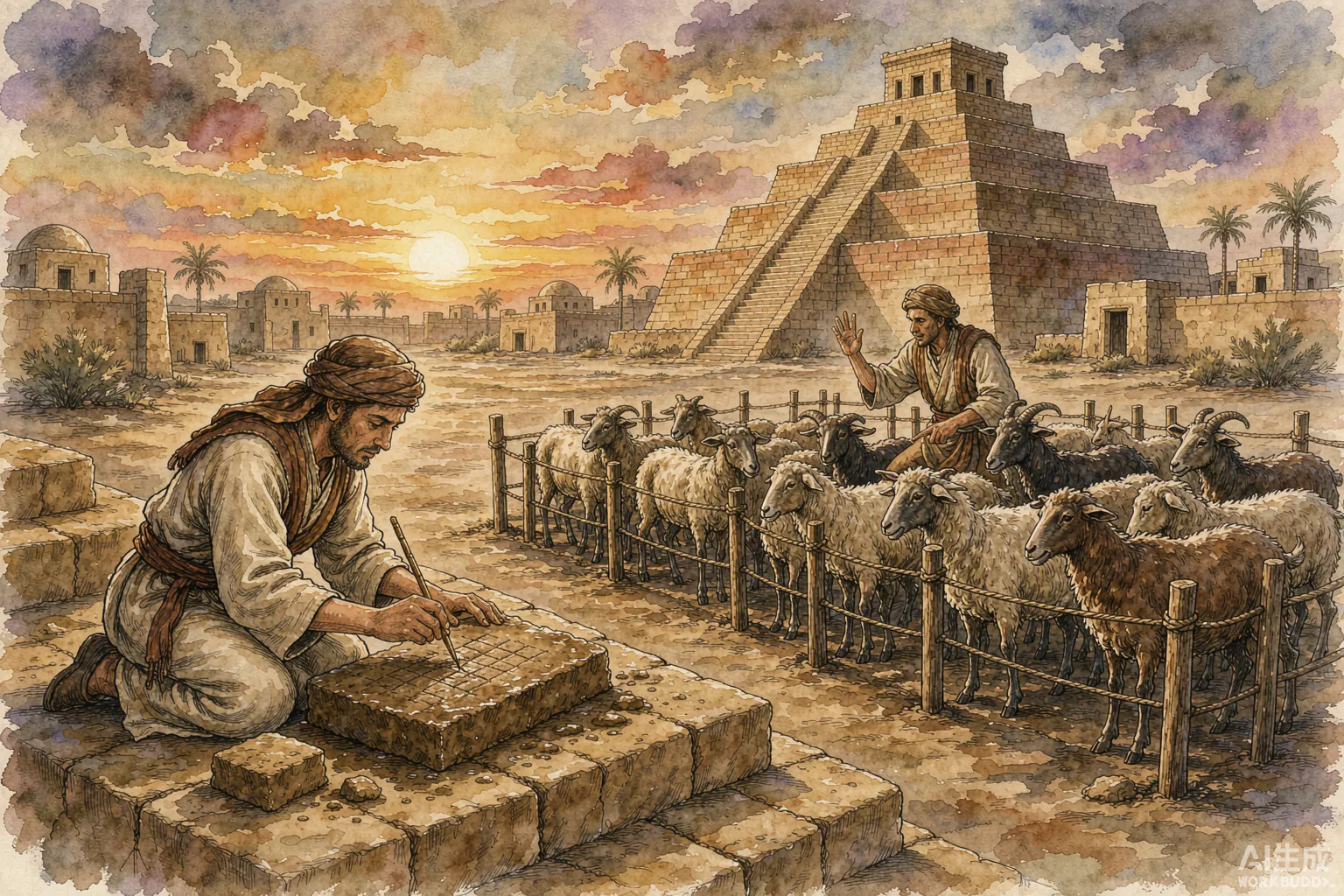
Historian's NarrationNow comes the page that fascinates me most in this book: humanity's earliest writing was, to a large extent, invented to keep accounts for sheep. The earliest clay tablets unearthed from the city-state of Uruk mostly record the counting and distribution of sheep and grain. To "write down three hundred sheep" on a clay tablet, you first need an abstract concept of numbers — the need to manage large flocks forced the invention of symbols, numbers, and writing. And it doesn't stop there: the Latin word for money, pecunia, comes from pecus (livestock); the ancestor of the English word "fee" also meant "livestock"; and "capital" originally meant "the head count of cattle." In Chinese, look at these four characters — 美 (beauty — a big sheep makes beauty), 善 (goodness), 義 (righteousness — the sheep above me), 群 (flock) — each one carries a sheep on top. A single species settled into the deepest symbolic systems of two civilizations.
◆ Historian's Note: Abstract Thinking "Midwifed" by Livestock
Historians often credit writing to temples and royal power, but archaeological evidence points to a humbler path: concrete things (sheep) gave birth to abstract tools (numbers, symbols, writing). The same logic also created money — when "one sheep" can stand for "ten bags of grain," the abstraction of value has begun. You could say that sheep were the springboard for humanity's leap from "things" to "symbols." Next time you see the character for "beauty" (美), remember the sheep on top: in the eyes of the people who invented writing, a plump sheep was goodness, was beauty, was righteousness.
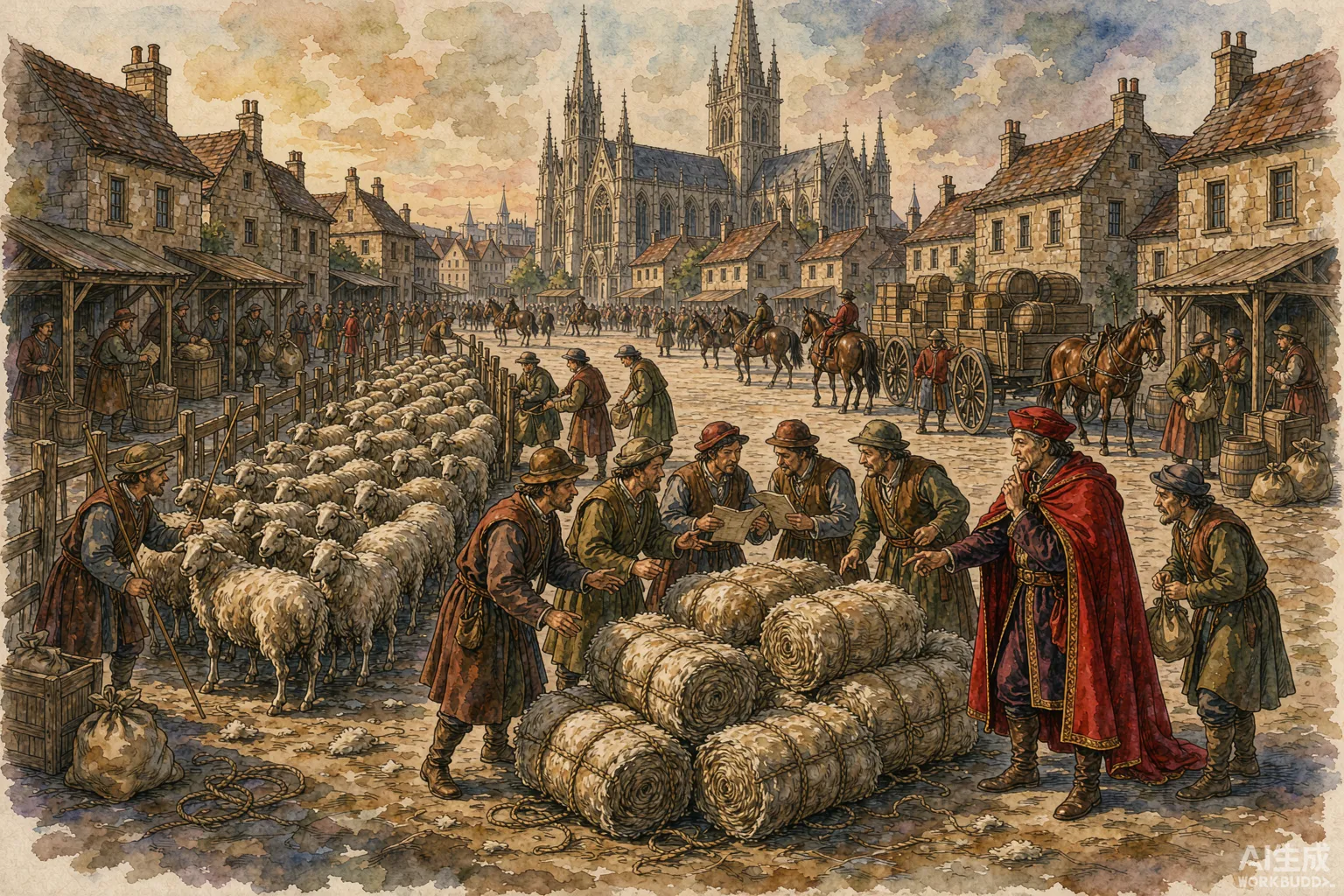
Historian's NarrationBy medieval Europe, wool had become a true "hard currency." England accumulated royal wealth through wool and cloth exports — to this day, the speaker's seat in the House of Lords is still called the "Woolsack." The Medici family of Florence rose from the wool guilds, then moved from banking to sponsoring the Renaissance. Spain treated its Merino fine-wool sheep as a national treasure and monopolized them, even banning live sheep exports for a time. But there's another side to the coin: when wool prices soared, lords fenced off farmland to turn it into pasture, driving tenant farmers from their homes. In 1516, Thomas More wrote that famous accusation in Utopia: "Sheep, once so gentle and modest in their appetites, have now become so greedy and fierce that they even devour men." "Sheep eat men" really means the price of wool was eating people alive.
◆ Historian's Note: The Prototype of "Globalization" Seen Through Wool
A single wool chain linked half the world: English pastures — Flemish looms — the Antwerp exchange — Mediterranean Merino sheep. Prices fluctuate at one end, and destinies are overturned at the other — this is the world after markets connect strangers into one body. The Enclosure Movements were brutal, yet they also pushed landless farmers into cities and workshops, preparing the labor force for the Industrial Revolution that followed. Historians don't defend it, but they must understand it: every leap in economic systems has someone paying the price.
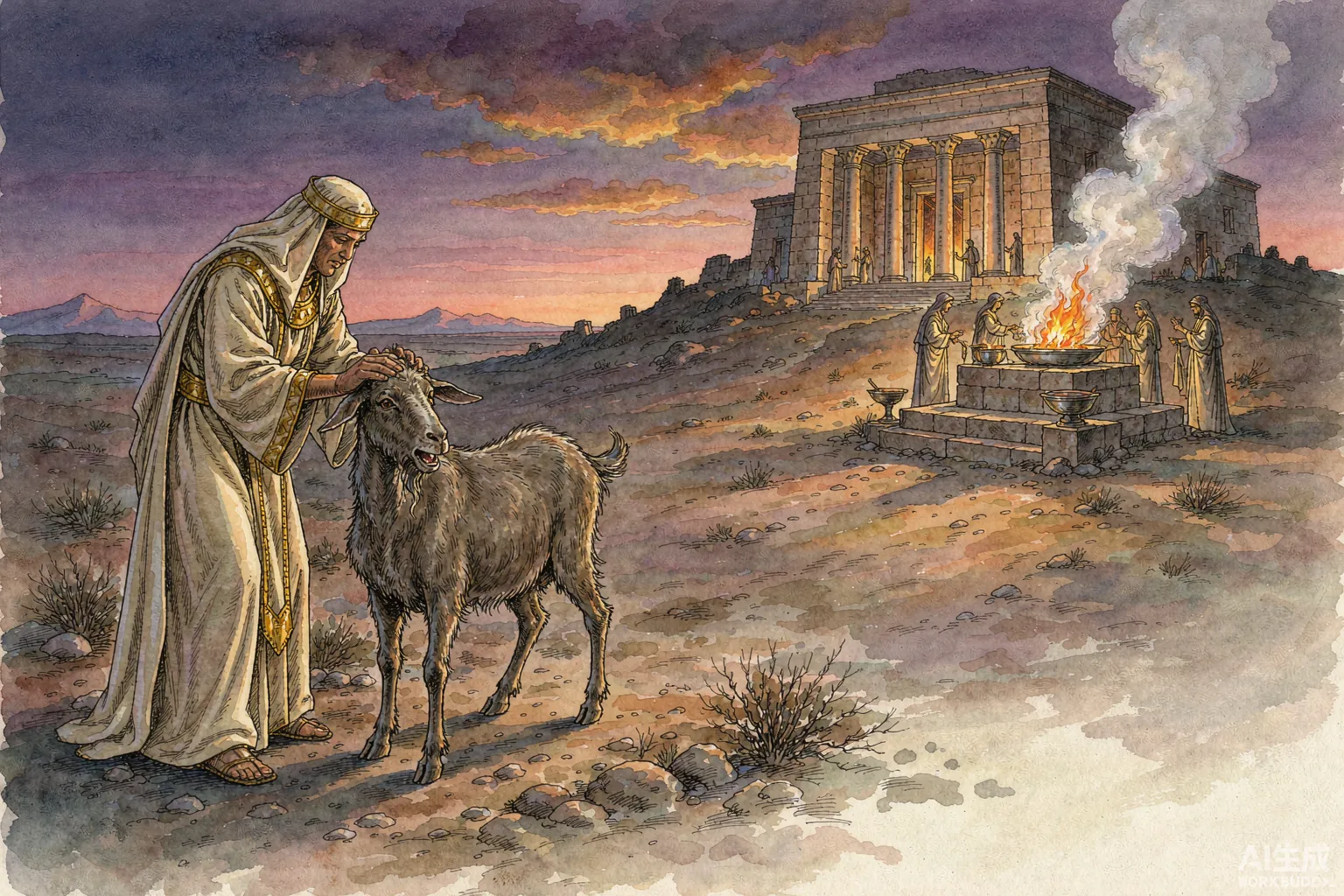
Historian's NarrationThis page calls for a quieter tone. In the ancient Hebrew Day of Atonement ritual, the high priest would lay his hands on the head of a goat and declare that the sins of the entire people were transferred onto it, then send it into the wilderness — this is the origin of the "scapegoat." In many ancient civilizations, sheep played similar ritual roles: as humanity's earliest and closest domesticated companion, the sheep was entrusted with the heavy task of "carrying away" invisible disasters on behalf of humankind. Today the word has stepped out of the temple: when a group is pushed forward to bear all the blame, we still say — "they're looking for a scapegoat." The ritual has changed, but the mechanism remains.
◆ Historian's Note: Ritual — Humanity's Earliest "Emotional Management Technology"
Loading abstract disaster into a concrete, visible, sendable object was how ancient humans dealt with collective anxiety. Its social function was real — it allowed the community to reunite after the ritual; its moral risk was equally real — the innocent bore responsibility that was not theirs. The task of history is right here: understanding why the ancients needed rituals, while also staying alert to any era's practice of "pushing out a sheep to calm the crowd." Please remember this warning — it belongs to every age.
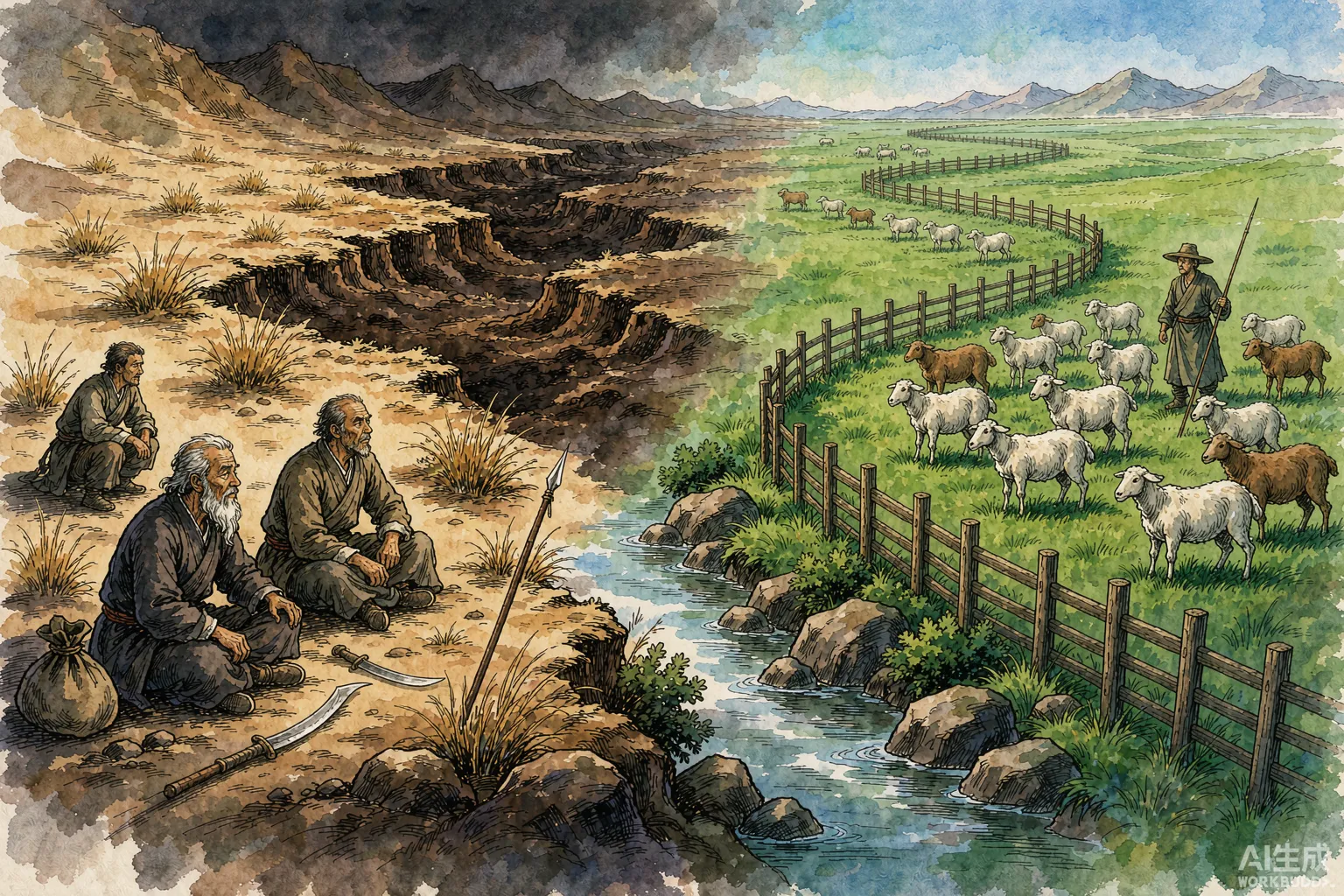
Historian's NarrationThe relationship between sheep and grassland is humanity's earliest "ecological bill." Pastures are vast, but their output is limited; flocks are gentle, but the cumulative power of grazing can strip the skin off a hillside — from the hills of the ancient Near East to today's many arid grasslands, overgrazing and land degradation always go hand in hand. What's interesting is that herders across continents independently developed a response: transhumance — the vertical seasonal migration in the Alps, the winter and summer pastures of Central Asia and the Tibetan Plateau. The essence is the same: giving the grassland "time to breathe." Tradition is not backward — many transhumance routes are a sustainability textbook written across mountains and rivers.
◆ Science Insight: Carrying Capacity and the "Tragedy of the Commons"
The number of sheep a grassland can sustainably support is called its carrying capacity. Exceed it, and roots are grazed away, soil is exposed, and degradation accelerates — recovery is far slower than destruction. Economist Garrett Hardin described a structural dilemma: the "Tragedy of the Commons" — a pasture that everyone has the right to use but no one is responsible for will inevitably be overgrazed. The solution was demonstrated long ago by the ancients:划定 grass strips for rotation, agree on rest seasons for grazing, negotiate rules collectively. You'll find that many solutions discussed in modern environmental management still revolve around these same old pieces of wisdom.
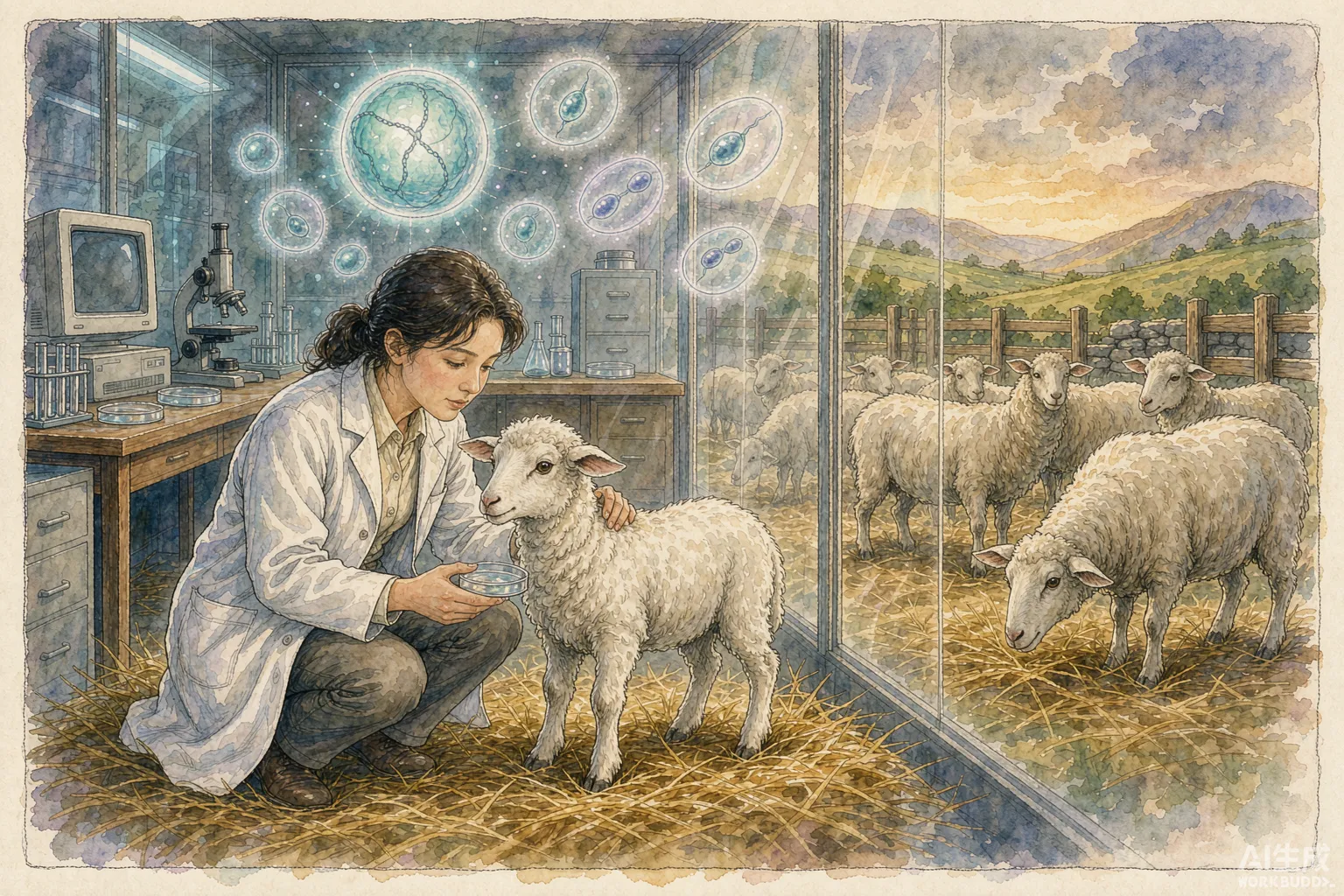
Historian's NarrationOn July 5, 1996, at the Roslin Institute in Scotland, a lamb was born. The team had taken a mammary gland cell from a Finnish Dorset ewe, transferred its nucleus into an enucleated egg cell — 277 attempts, 29 embryos — and only one survived. She was Dolly, the first mammal cloned from an adult somatic cell. Her name came from country singer Dolly Parton — after all, the donor nucleus came from a mammary gland, and scientists do have a sense of humor. Dolly's birth announced: the entire genome of an adult cell can be "reset" back to the starting point of life. For the next several years, she lived healthily and had offspring, until her passing in 2003.
◆ Science Insight: Cloning Proved "Expression" Can Be Reset
The genes in a mammary cell and an egg cell are completely identical, yet one is a mature cell and the other gives rise to a totipotent life — the difference lies entirely in the state of gene expression. The key to cloning is epigenetic reprogramming: factors in the egg cell broadly erase the "switch labels" (DNA methylation, histone modifications) on the adult cell's genome, allowing the developmental program to start from scratch. Dolly is therefore the most dramatic experimental validation of the recurring theme in this series — the same genome, different expression states. In her later years, her telomeres were shorter, suggesting that reprogramming is not always perfect — and reminding us that life's epigenetic records are more stubborn, and more subtle, than we thought.
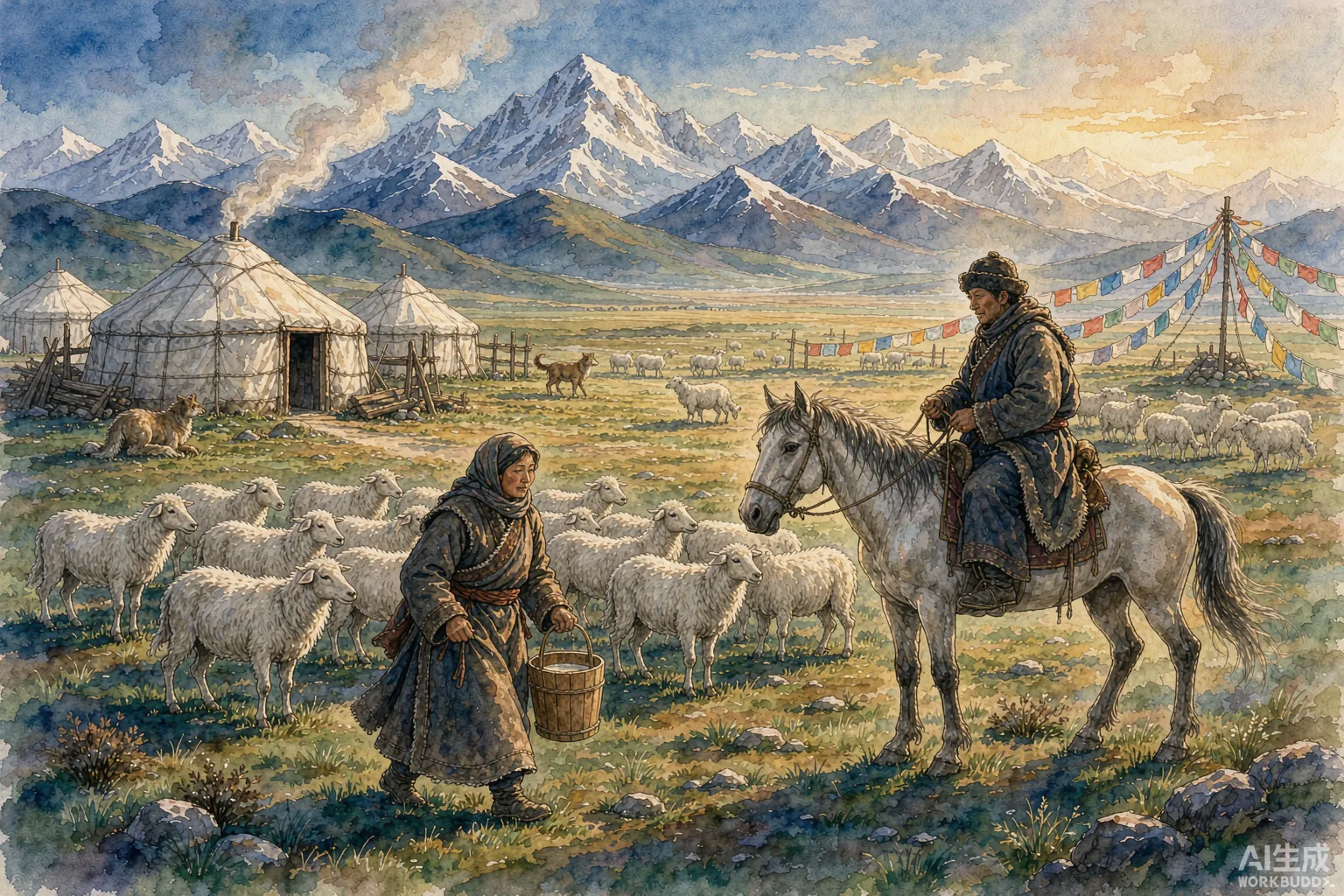
Historian's NarrationSheep haven't exited the stage like horses did. They're still on our backs today: the cashmere sweater you wear, the wool in your suit, the woolen blanket around a baby. Across the world's highlands and mountains, Tibetan sheep and alpine fine-wool sheep remain the livelihood of millions of herding families. But change is happening: petroleum-based polyester fiber has captured wardrobes at lower prices, also leaving microplastics in the wash water — humanity is discovering for the first time that "cheaper alternatives" come with their own bills. Meanwhile, ancient sheep breeds, transhumance routes, and herders' knowledge are now, along with grassland ecosystems, things that need to be carefully protected. After ten thousand years of walking together, it's time to renegotiate the terms.
◆ Historian's Note: Alternatives Also Have Their Price Tags
Remember the horse manure crisis and automobiles from Book Two? History repeatedly demonstrates the same rule: new technologies solve old problems but often sign new bills. Polyester fiber liberated the wool supply, but brought microplastic pollution. This reminds us that when evaluating "alternatives," we should ask three questions like historians — what did it replace? What did it add? Who is paying for what was added? The debate between wool and synthetic fiber is essentially a competition between two cost-accounting methods: one only counts the price tag, the other counts the grasslands and oceans too.
Historian's NarrationThe three comic books can now be closed, but please take these three sentences with you. About horses, we learned: distance is power — whoever connects farther defines the era. About pigs, we learned: relationships are evolution — the same genome can produce vastly different expression. And about sheep, we learned: civilization's "soft power" is often carried by the quietest of companions — sheep pushed humanity to invent writing and numbers, wove the wealth of cities, bore the projection of human fear of the unknown, and finally helped us verify that gene expression can be reset.
Over ten thousand years, sheep never wrote a single word, yet they stand within the very earliest words. They taught humans abstraction, accumulation, and empathy, and also reflected greed, avoidance, and cost. History, after all, is just this: one domestication after another between humans and the ten thousand things — and who the star of the next book will be actually depends on how we today make covenants with every living thing around us. May you, after closing this comic, walk upon a hillside, through a field, or at a city corner, and recognize those silent old friends.
◆ Three Questions for the Entire Series (Discuss with classmates, then write down your answers)
1. Without sheep, would writing, currency, and concepts like "beauty," "goodness," and "righteousness" have been born through other paths? Please reason out one possible alternative path.
2. From the mouflon to the fine-wool sheep to Dolly, among humanity's three "interventions" with sheep (management, selective breeding, reprogramming), which carries the greatest ethical weight? Why?
3. Drawing on all three books: what is the "legacy" that horses, pigs, and sheep each left for humanity? What future of human civilization do they together point toward?