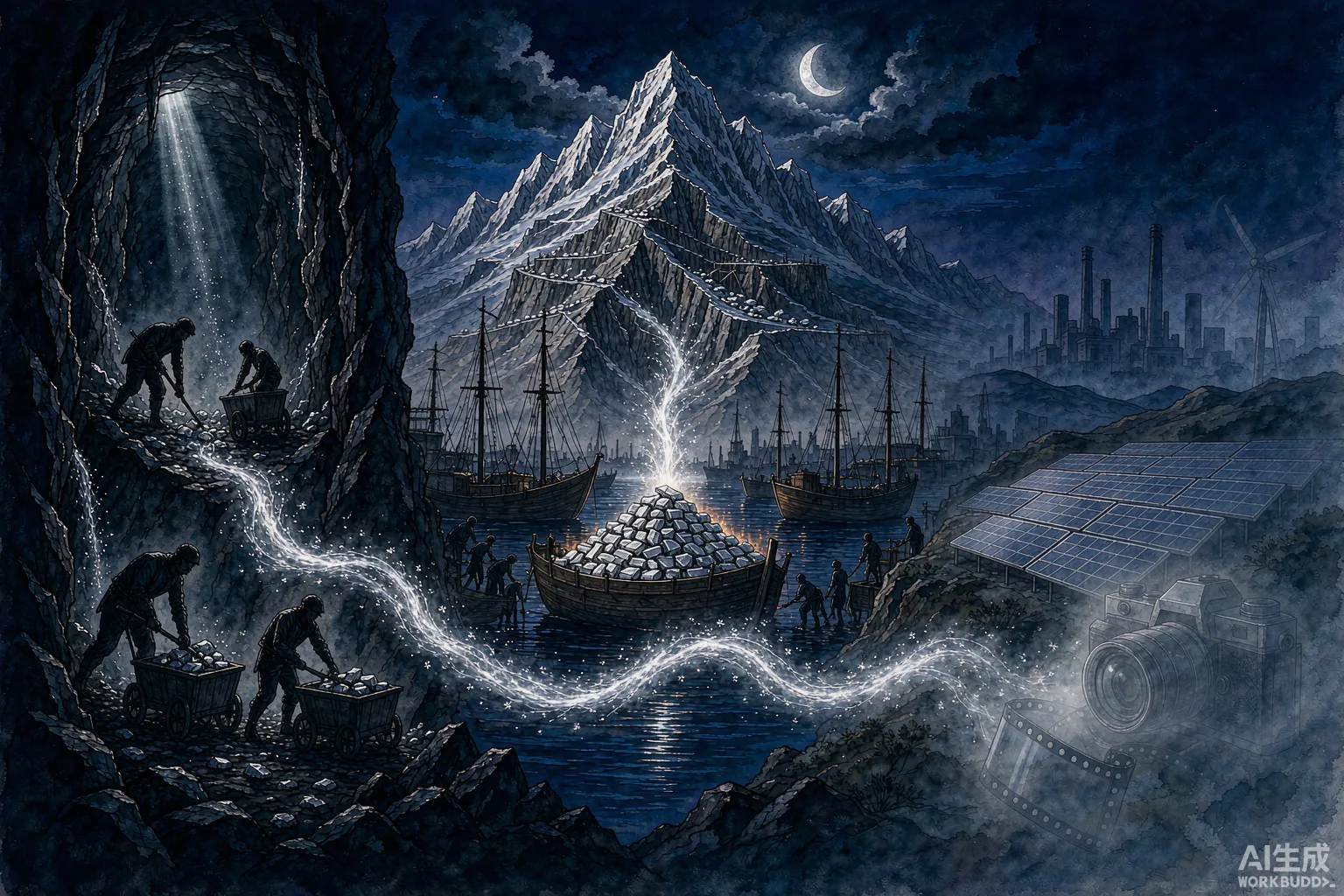
"Gold is the sun, silver is the moon," the medieval alchemists said. The sun burns alone, but moonlight spills over every night market.
The Metal of the Moon
The Story of ElementsSilver's elemental symbol Ag comes from the Latin argentum, whose root meaning is simply "shining, whitish." Alchemists dedicated gold to the sun and silver to the moon—this pairing contains half the truth of metal history: gold is so rare it belongs only to temples, while silver is abundant enough to enter the daily lives of countless households. In the Earth's crust, silver is about fifteen to twenty times more abundant than gold; its status as the second most precious metal allows it to equally bear value; its greater abundance, better conductivity, and superior malleability make it willing to "roll up its sleeves and get to work." A metal's destiny is already drafted on the periodic table of elemental abundance. And notice the linguistic coincidence: French argent (silver) also means "money," and the Romans used pounds of silver to account for the renovation of the Temple of Diana— in many languages, "silver" and "money" are originally the same word.
◆ Scientific Insight: The Chemistry of Tarnished Silver and the Truth About "Silver Needle Testing for Poison"
Silver jewelry turns black over time because silver reacts with sulfur compounds in the air or food to form black silver sulfide. Ancient "silver needle testing for poison" was actually somewhat accidentally correct: arsenic refined by old methods often contained sulfur impurities, so a silver needle would turn black when probed—but silver cannot detect the poison itself; it knows nothing about today's sulfur-free poisons. However, silver has real abilities: silver ions have definite antibacterial properties—they can destroy bacterial cell membranes and metabolic enzymes. From ancient Roman silver vessels for holding water, Mongol armies' silver wound dressings, to modern medical dressings, catheter coatings, and newborn eye drops, "silver can inhibit bacteria" is a story that moved from experience to the laboratory. A half-right, half-wrong ancient legend is precisely a good example of history and science each seeking truth in their own way: history explains where it came from, chemistry explains which half was wrong.
One Mine That Fed a Navy
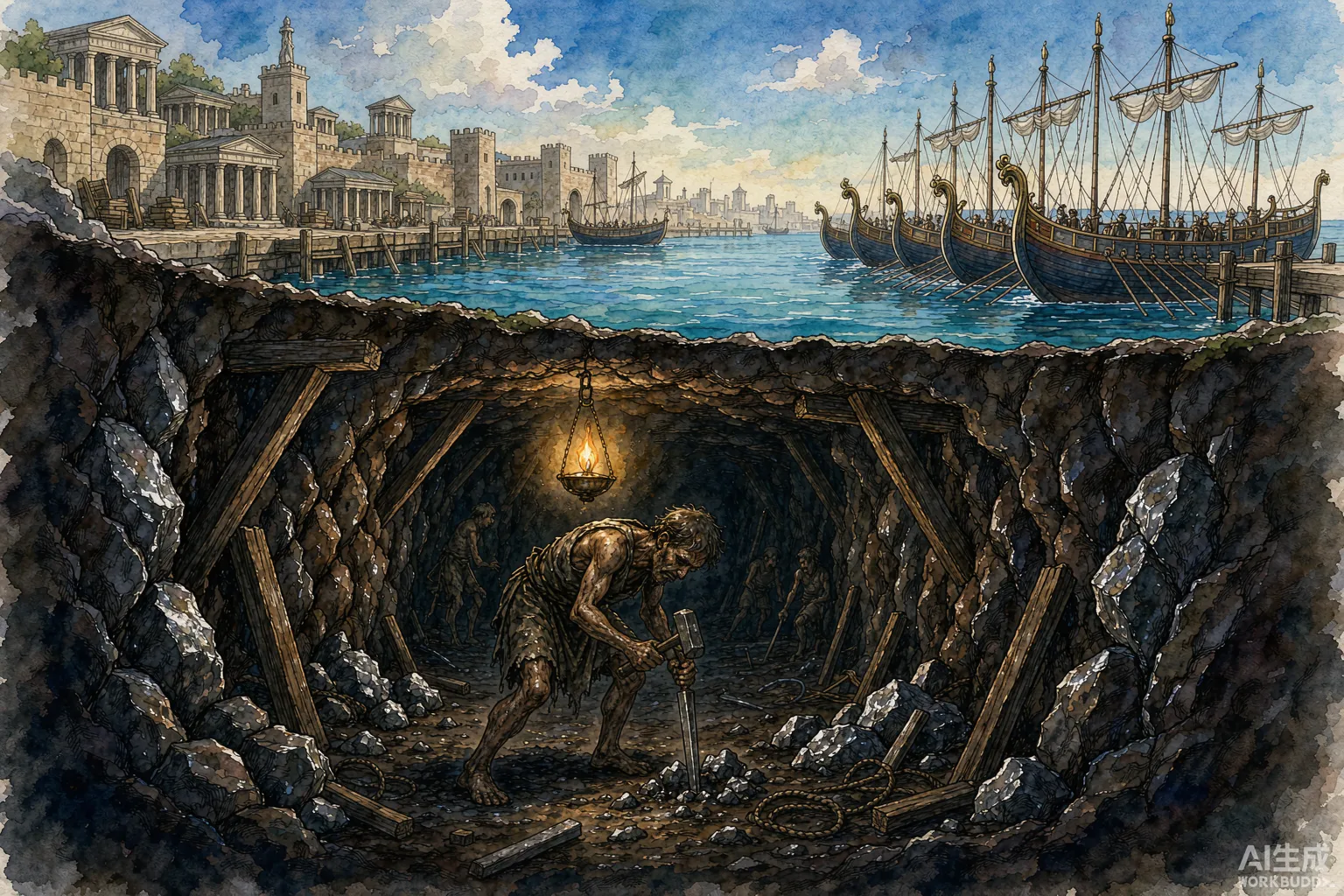
5th Century BC · AthensThe first time silver profoundly turned history happened in Athens. In 483 BC, the Laurion silver mines unexpectedly struck a rich vein, and the treasury swelled. By convention, this windfall should have been distributed among all citizens—Athens was famous for its egalitarianism. But the statesman Themistocles overrode all opposition: use this silver mine income to build two hundred new trireme warships. Seven years later, it was precisely this "silver mine fleet" that crushed the Persian fleet at the Battle of Salamis, rewriting the course of the Greco-Persian Wars. One silver mine equaled a civilization's life-or-death choice. But remember the other side of the ledger: beneath the veins, tens of thousands of slaves knelt and lay in tunnels less than a meter high, chiseling rock, many never to return. Archaeologists have discovered extensive slave settlement ruins and chains at the mining area—the silver gleam of Athenian democracy cast shadows in the mine tunnels. In the later stages of the Peloponnesian War, the Spartans simply occupied Laurion and cut off its silver source, and the Athenian empire bled out accordingly: the rise and fall of one mine was directly written into a hegemony's medical record.
◆ Historian's Note: Three Uses for a Windfall
Silver that falls from the sky can be distributed, stored away, or turned into a fleet. Themistocles' choice shows: the value of resources lies not in how much is dug up, but in what society decides to turn it into. This criterion remains as sharp in the oil age and data age as it was then.
Potosi: A Silver Mountain That Ate People
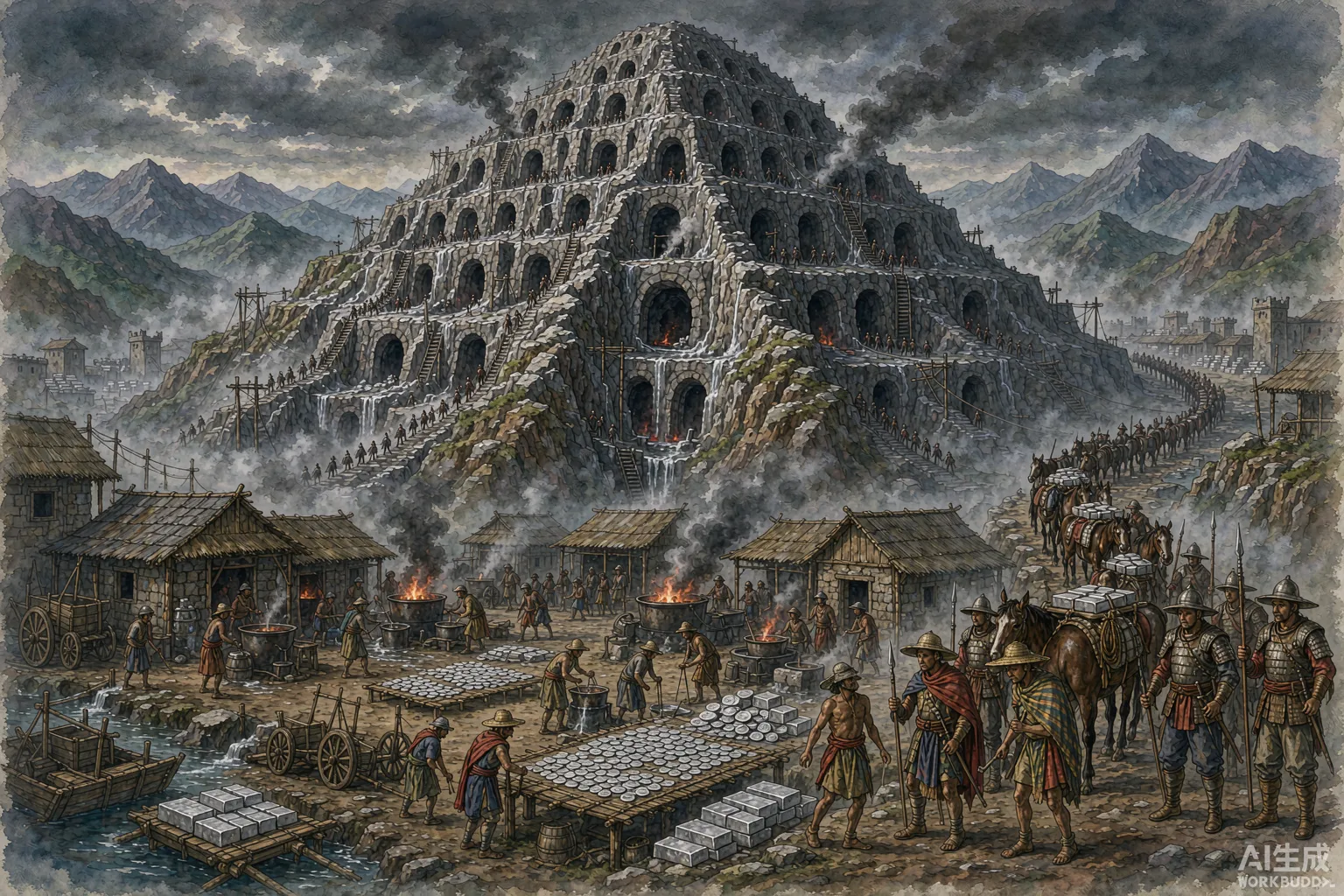
From 1545 · Spanish AmericaIn 1545, Spanish colonizers discovered silver veins in Cerro Rico (meaning "Rich Mountain") on the Andes plateau over four thousand meters above sea level, Potosi thus rose to prominence, with a population of about 160,000 at its peak, once exceeding most European capitals of the time. The Spanish used the mercury amalgamation method to extract silver in large quantities: mixing crushed ore with mercury salts into a slurry, letting the mercury "bite" the silver, then heating to evaporate the mercury and leave the silver—production skyrocketed, but mercury vapor simultaneously poisoned the workers' nerves and bones. The colonial authorities conscripted indigenous people for the "mita" rotation system, annually drafting tens of thousands according to lists to enter the mountains, countless dying from tunnel collapses and mercury poisoning; mule and alpaca caravans worked day and night, carrying silver ingots to the coast. The "pieces of eight" minted in Potosi became global hard currency, church bells and mine groans echoing in the same mountain. The local coins once bore a boastful inscription—"Rich Potosi, the treasure of the world." The world's treasure was exchanged for the world's wounds.
◆ Historian's Note: The Price Revolution—Silver Can Also "Inflate"
After American silver flooded into Europe, prices rose continuously throughout the 16th century, in what is known as the "Price Revolution." This was the first time humanity witnessed with its own eyes: the total amount of money itself changes the value of money. Kings thought finding a gold mine meant finding national power, but what they dug up was rising prices and debt—and ironically, most of the silver just passed through Spain: squandered on wars, then flowing to Genoese and Antwerp bankers, while Spain itself suffered industrial hollowing and mounting debts. Countries that find gold mines don't necessarily get rich, just as lottery winners aren't necessarily happy—the value of money lies in what it buys, what it becomes. Silver gave European empires leverage, and also gave them their first systematic lesson in money.
◆ Scientific Insight: Pollution Still Unpaid After Five Hundred Years
The bill for the amalgamation method has dragged into today. Large amounts of mercury from the silver extraction process flowed into rivers and lakes with wastewater, spreading across South America through water systems; soil and water around Potosi still show high mercury concentrations today—this is one of the earliest and longest-lasting heavy metal pollution cases in human industrial history. Meanwhile, Cerro Rico, hollowed out for over four hundred years, has unstable structure and ongoing collapse risks; UNESCO has placed it on endangered watch. The history of the silver mountain has no "past tense": problems from the mine tunnels are still dripping bills to the city below. This is what environmental history reminds us: economic accounts can be settled, ecological accounts often remain outstanding.
Silver Flows East: A Silver River Spanning the Pacific
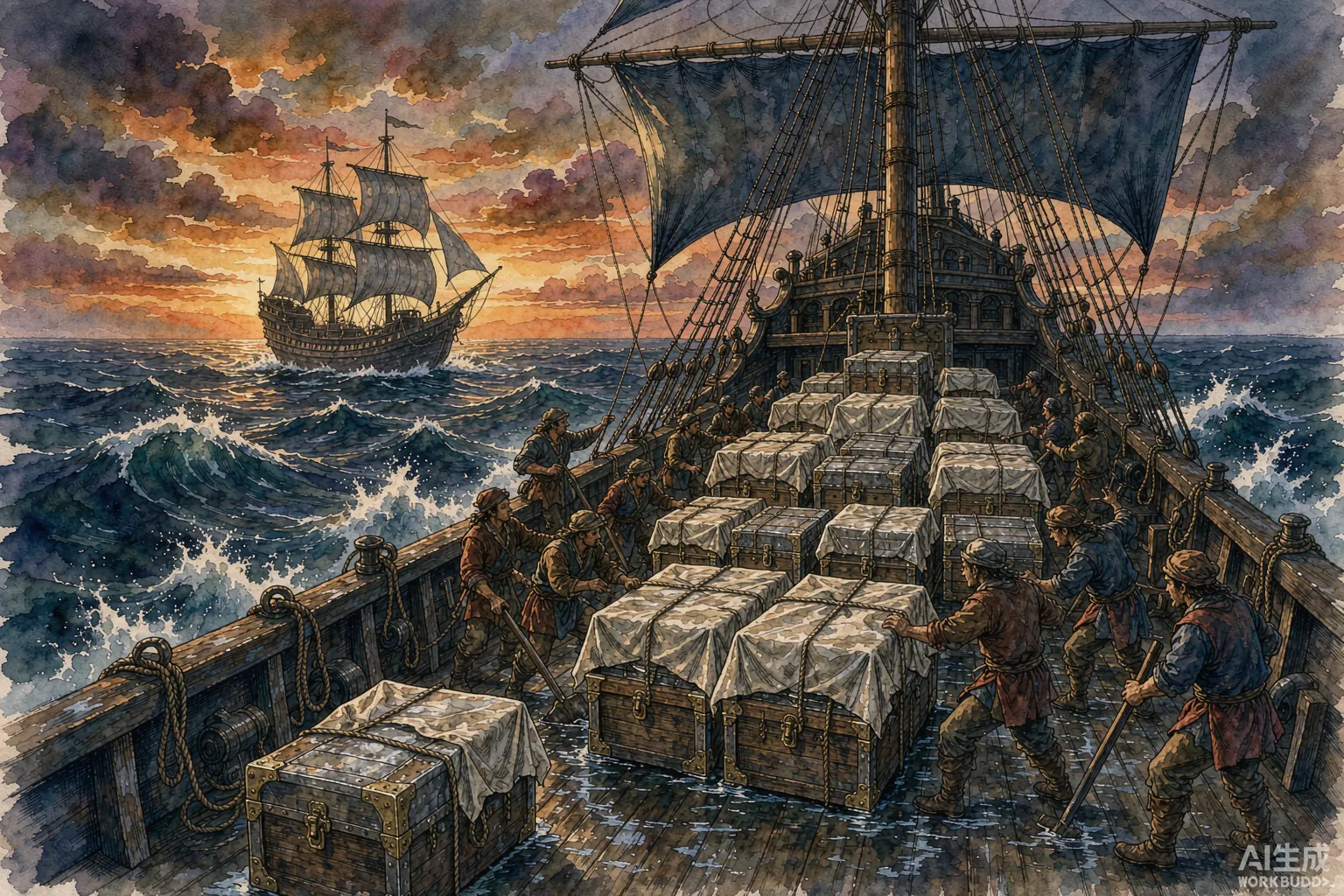
1565–1815 · Global TradeMost of the world's silver ultimately flowed to the same place—China. Ming Dynasty China had a huge population and thriving commerce, and after paper currency credit collapsed, silver became the de facto main currency: in 1567, the Longqing Opening allowed private overseas trade, and in 1581, Zhang Juzheng implemented the Single Whip Reform, unifying land taxes and corvée labor into silver payments—from then on, an empire with four hundred million acres of farmland tied its own finances to silver. And China's huge appetite for silver in exchange for silk, porcelain, and tea stitched the Americas and Asia together: Spanish galleons crossed the Pacific annually, bringing American silver via Manila to China; scholars estimate that about thirty to fifty percent of American silver ultimately flowed into China. The Manila galleon route operated for two and a half centuries—it was humanity's first true "globalization" blood transfusion line.
◆ Historian's Note: The Birth of Global History
Traditional history divides chapters by nation; silver's history is written precisely in the cracks between all nations. Potosi miners, Seville accountants, Manila sailors, Jiangnan weavers, the Minister of Revenue in the capital—they didn't know each other, yet shared the same "moon." What global history perspective teaches us is precisely this way of seeing: reading scattered shorelines as the same river.
Silver Famine and Smoke: Silver and Modern China's Labor Pains
17th–19th CenturiesTying finances to an imported metal means sharing fate with distant mines and shipping routes. In the 1630s–40s, American silver mines declined, Japan closed its borders, trade fluctuations叠加, and silver flowing into China sharply decreased, silver became expensive and grain cheap, worsening late Ming finances and livelihoods—Qing historians still debate its weight in the Ming Dynasty's collapse. By the 19th century, the problem recurred in more cruel ways: opium smuggling caused massive silver outflows from China, expensive silver, cheap copper coins—farmers exchanged copper coins for silver to pay taxes, burdens doubled, social contradictions intensified, ultimately converging into the great waves of the Humen opium destruction and the Opium War. The "Opium War" in history textbooks, in silver's ledger, is another rerouting of this global silver river. The smoke at Humen and the snow at Potosi, separated by two centuries and half a globe, were originally the same storm.
◆ Historian's Note: Monetary Sovereignty, a Concept Taught by History with Blood
Ming and Qing experience connects into one conclusion: when a large country's pricing, tax payment, and savings all depend on a metal it cannot control, mine disasters, shipping routes, and wars in any corner of the globe will become its domestic grain prices and tax burdens. "Monetary sovereignty" as four characters is a concept written into textbooks only after generations paid the price.
Twilight of Silver Dollars: From Eagle Dollars to Fiat Currency
1850–1935Silver's curtain call in China came later than many imagine—until the 20th century, Chinese money was still silver coins. From the late Qing to the Republic of China, the standard Mexican "Eagle Dollar" and domestically minted "Yuan Shikai" silver dollars circulated in parallel, wages, land rents, and wedding dowries were still priced in silver dollars—the daily economy of over four hundred million people still ran on a metal. But the world had changed: during the Great Depression, to rescue domestic silver mining interests, the United States passed the Silver Purchase Act in 1934 to buy silver at high prices. International silver prices skyrocketed overnight, and China's silver flowed out like blood being drawn—silver dollars melted into ingots, loaded onto ships for export, immediately causing domestic credit tightening; tight credit meant factory closures and farmer bankruptcies. History's irony lies in this: this disaster wasn't because silver depreciated, but because silver "appreciated"—whether rising or falling, as long as your money is anchored to prices others manipulate, destiny isn't in your own hands. In November 1935, the National Government was forced to implement fiat currency reform: abolishing the silver standard, nationalizing silver, switching to unbacked state paper money. China's nearly four-hundred-year silver age ended in an external storm. The exam questions any country's central bank must answer today—exchange rate systems, foreign exchange reserves, monetary independence—China in 1935 had already paid tuition with ship after ship of flowing silver.
◆ Historian's Note: A Rehearsal of the "Impossible Trinity"
Modern economics says a country cannot simultaneously achieve "exchange rate stability, free capital flow, and independent monetary policy"—the so-called Mundell "Impossible Trinity." China in 1935 was a classic case forced into a corner by this triangle: the silver standard let exchange rates float with international silver prices, capital (silver) flowed freely out, monetary policy had no room to fight back. Behind the abstract models in textbooks are often real bankruptcies and turnarounds of some country. The value of reading history lies in restoring formulas to their costs.
Keeping the Light: Silver's Second Life
1839 to Present · Science and IndustryBeyond currency, silver found a quieter second life—keeping the light. Silver salts are extremely sensitive to light: in 1839, the daguerreotype process was announced, and humanity first fixed images on silver-plated copper plates; for the next century and a half, every sheet of film and photographic paper was coated with a layer of silver salts, all of humanity's shared memories almost all developed on silver's surface. Meanwhile, silver also entered life in other roles: among all metals it has the best electrical and thermal conductivity (which is why it remains in high-end circuits), antibacterial silver dressings in hospitals, and today's every solar panel—photovoltaic silver paste turning sunlight into electric current efficiency also离不开 this layer of silver's hustle. From Daguerre's copper plates to rooftop photovoltaic panels, silver transformed from "weighed wealth" to "working metal."
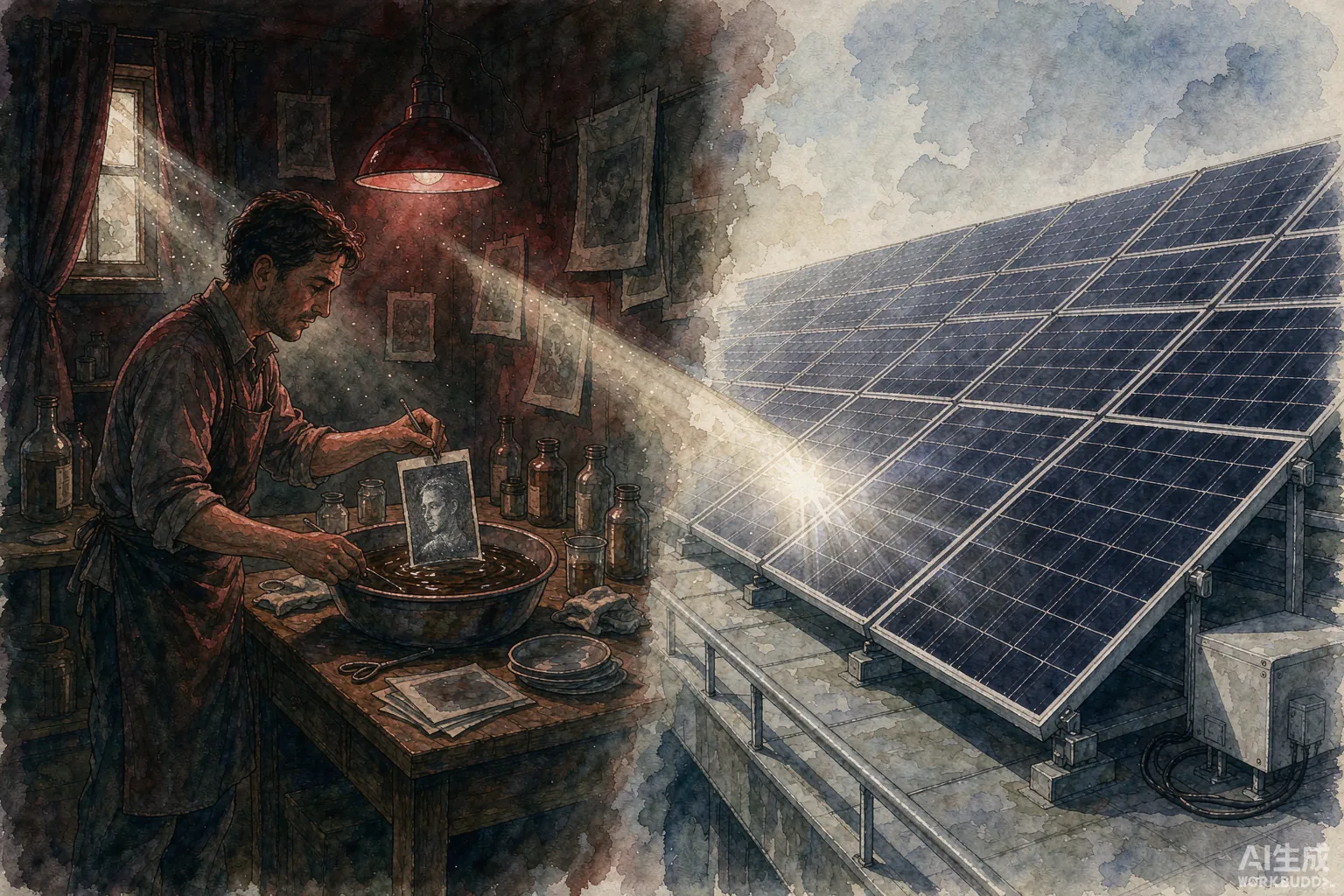
◆ Scientific Insight: Why Did Photography Choose Silver?
Silver halide crystals have a wonderful property: after exposure to light, they decompose into extremely fine metallic silver particles, forming an invisible "latent image," which developers then amplify a hundred million times into visible images. The whole process only needs light and chemicals, equivalent to translating "light's history" into "silver's history." In the digital age, silver halides have retreated to the margins, but the "exposure-development" principle pioneered by silver remains the foundation of photosensitive science. On today's solar panels, the fine silver grid lines on the front are responsible for "catching" the electrons excited by every ray of light—in a sense, photovoltaics is photography's sequel: back then silver kept light for humanity, now silver collects light for humanity.
Sun and Moon, Each Illuminating Their Own Human Realm
Written for Future ReadersPlacing the two chapters side by side, you'll see clearly the personalities of this pair of metal brothers: gold is chemically the most "lazy," so humanity entrusted it with "unchanging"—divinity, royal power, savings, and a sense of security; silver is more active, more abundant, so history assigned it to "flow"—coinage, trade, globalization's blood, and industry's sinews. One is responsible for constancy, one for circulation, together they make a complete value system—just like the sun and moon.
And what silver leaves to historians is the world's earliest "world economic network map": miners, shipowners, emperors, weavers connected by the same silver river, none able to independently determine their own fate. From Potosi to Manila, from Zhang Juzheng to the 1935 fiat currency reform, silver proved time and again: entrusting destiny to something you cannot control, whether a mountain, a shipping route, or an act, the price will ultimately be paid by the most silent. The six protagonists of this series—horse, pig, sheep, gold, silver—are actually saying the same thing: human history is the grand account of sharing everything on this planet, mutually domesticating, mutually illuminating.
◆ Three Questions for the Whole Article
1. Compare gold and silver: what corresponding relationships exist between abundance, chemical activity, and "social role"?
2. From Laurion to Potosi, workers in the tunnels are almost never absent from wealth narratives—why must monetary history reserve chapters for them?
3. In 1935, China bid farewell to the silver standard. If you were to nominate a successor to silver for today's "globalization blood vessels," what would you choose? What new "Potosis" has it brought?
Silver Timeline
483 BC Laurion silver mines and Athenian fleet · 1545 Potosi silver mines discovered · 1565 onward Manila galleon route · 1567 Longqing Opening · 1581 Single Whip Reform · 1640s Late Ming silver famine · 1839 Daguerre photography process · 1934 US Silver Purchase Act · 1935 China fiat currency reform · Today Photovoltaic and antibacterial industries in parallel